Introduction
The electric vehicle revolution is no longer a distant promise; it is parked in our driveways.1 As we move into 2026, EV adoption has skyrocketed, yet one psychological hurdle remains: range anxiety. Even with modern EVs boasting 300+ mile ranges, the fear of being stranded with a “0%” battery icon persists.
Enter the Portable Electric Vehicle Charger. Often described as the “jerry can” of the 21st century, these devices are evolving from niche emergency tools into essential gear for specific types of drivers. In this comprehensive guide, we will explore everything you need to know about the portable electric vehicle charger, from technical specs to real-world applications that go far beyond a simple emergency boost.
What is a Portable Electric Vehicle Charger?
In the simplest terms, a portable electric vehicle charger is a mobile power solution designed to provide electricity to an EV when a fixed charging station is unavailable.2 However, the term is often used to describe two distinct types of hardware:
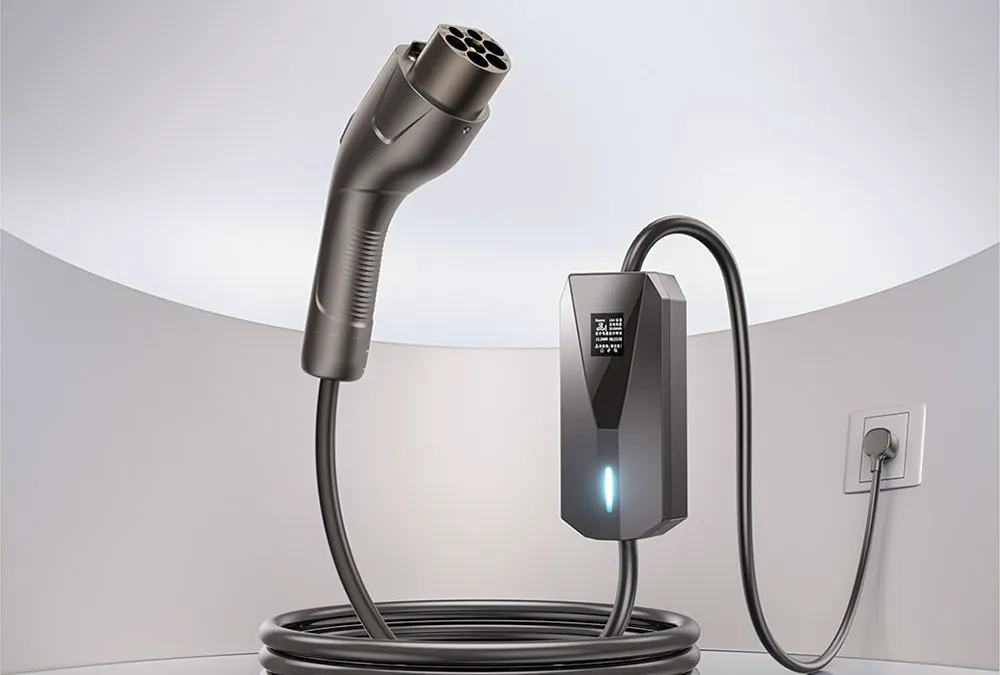
- Mobile Charging Cables (Grid-Dependent): These are high-quality, weather-resistant cables with an integrated controller. They allow you to plug your car into a standard wall outlet (NEMA 5-15) or a high-powered industrial outlet (NEMA 14-50) anywhere you find one.
- Portable Battery Power Banks (Off-Grid): This is a portable charger ev owners use when there is no plug in sight. It is essentially a massive lithium-ion battery in a ruggedized case that can dump a specific amount of kilowatt-hours (kWh) into your vehicle’s battery via a DC or AC connection.
While a smartphone power bank fits in your pocket, a portable electric car charger for a vehicle is significantly larger—ranging from the size of a briefcase to a small suitcase on wheels.
Why the Demand for Portable EV Chargers is Surging
You might wonder: If there are thousands of public chargers, why do I need a portable one? The answer lies in the unpredictability of travel and the limitations of current infrastructure.
1. The “Broken Charger” Syndrome
The most common frustration for EV drivers isn’t the lack of chargers—it’s arriving at a station to find it out of order. A portable ev charger acts as your secondary insurance policy.
2. Pushing the Boundaries of Exploration
For the adventurous driver, the best destinations are often the ones furthest from a Tesla Supercharger or an Electrify America hub. If you are overlanding in the desert or heading to a remote cabin, a portable electric vehicle charger provides the “buffer” needed to explore with confidence.
3. Urban Living Challenges
Many EV owners live in apartments or condos without dedicated stall charging.3 For these users, a high-capacity portable electric car charger can be charged at work or a friend’s house and used to “top off” the car while parked on the street.
Deep Dive: Types of Portable EV Chargers
Understanding the technical nuances of a portable charger ev will help you avoid spending money on the wrong equipment.
Level 1 & Level 2 Mobile Connectors
Most EVs come with a basic Level 1 cord. However, many owners upgrade to a more robust portable electric vehicle charger that supports Level 2 speeds.
- Level 1 Charger: Uses a standard 120V household outlet. It’s slow (adding about 3-5 miles of range per hour) but universally accessible.
- Level 2 Charger: Requires a 240V outlet (like a clothes dryer plug). These portable units can add 20-30 miles of range per hour, making them a viable primary charging solution for people who travel between two fixed locations (e.g., a primary home and a vacation rental).
Commercial vs. Consumer Battery Units
- Consumer Grade: Typically offers 3-10 kWh of energy. This is enough to get you 15-30 miles—just enough to reach the next high-speed charger. These are designed to fit in your trunk (frunk).
- Commercial Grade: Used by roadside assistance companies.4 These can hold 20-50 kWh and provide “Fast DC” charging. These are too heavy for a standard trunk and are usually mounted on trailers or in the back of service vans.
User Personas: Who is the Portable EV Charger For?
To decide if you need a portable electric vehicle charger, let’s look at the four types of drivers who benefit the most:
The “Peace of Mind” Commuter
This driver rarely goes below 20% battery but suffers from significant anxiety during winter months when range can drop by 30%. For them, a compact portable ev charger stays tucked under the floorboards, never used but always providing psychological comfort.
The Remote Worker/Digital Nomad
If your “office” is a van or an EV parked by a lake, you are likely drawing power for laptops, Starlink, and heaters. A portable electric car charger ensures that your “work from anywhere” lifestyle doesn’t leave you unable to drive back to civilization at the end of the week.
The Real Estate & Construction Professional
Professionals who spend all day driving between undeveloped job sites often find themselves far from charging hubs. A portable charger ev allows them to add a few miles of range while they are on-site inspecting a property or managing a crew.
The EV Fleet Manager
For businesses transitioning to electric delivery vans, a single stalled vehicle can ruin a day’s logistics. Keeping a commercial-grade portable electric vehicle charger at the warehouse allows the team to rescue a driver without calling an expensive third-party towing service.
How to Choose a Portable Charger EV: 5 Buying Factors
Not all chargers are created equal. Before you click “buy,” evaluate these five metrics:
1. Weight and Portability
A battery-based portable electric car charger is heavy.5 Lithium is dense. Ensure the model you choose has ergonomic handles or wheels. If it’s too heavy to lift in and out of your trunk easily, you won’t carry it with you.
2. Weatherproofing (IP Rating)
Charging often happens in the rain or snow. Look for a portable ev charger with at least an IP65 or IP67 rating. This ensures the internal electronics are protected from dust and water splashes.
3. Cable Length and Durability
In an emergency, you might not be able to park perfectly next to your power source. We recommend a cable length of at least 18 to 25 feet. The cable should also be “crush-proof,” capable of being stepped on or even driven over without failing.
4. Connector Compatibility
In North America, the J1772 and the NACS (Tesla) standards are the primary players. Ensure your portable electric vehicle charger matches your car’s port, or carry a high-quality, heat-tested adapter.
5. Smart Features
Premium portable charger ev models include Bluetooth or Wi-Fi connectivity. This allows you to monitor the charging speed and battery temperature from your phone, which is vital when charging in extreme heat or cold.
Application Scenarios: Beyond the Emergency
Let’s look at how a portable electric vehicle charger changes the way you use your vehicle.
Scenario A: The Multi-Day Camping Trip
You’ve driven your Rivian or F-150 Lightning to a national forest. You’re using the vehicle’s “Camp Mode” to keep the HVAC running and the lights on. By the third day, you’ve used 15% of your battery just on lifestyle. Having a portable ev charger (battery-powered) allows you to “refill” that 15% using solar blankets or a small portable generator, ensuring you have the full range needed for the drive home.
Scenario B: Helping a Fellow Driver
Being an EV “Good Samaritan” is the new “jumping a battery.” If you see another EV stranded on the shoulder, a portable electric car charger allows you to give them 10 miles of range in 20 minutes—enough to get them to safety—without needing to tow their vehicle.
Scenario C: Extreme Cold Snap
In sub-zero temperatures, an EV battery uses a significant amount of energy just to stay warm. If you are parked outside at a ski resort, your range might “bleed” overnight. A portable charger ev can be used to pre-condition the battery before you drive, saving your main battery for the actual trip.
Technical Comparison: Portable vs. Home Charging
| Feature | Home Charging Station (Level 2) | Portable EV Charger (Battery) | Mobile Connector (Cable) |
| Power Output | $7.2kW – 11.5kW | $3.6kW – 9.6kW | $1.4kW – 7.2kW |
| Portability | None (Fixed) | High (Self-contained) | Medium (Needs Outlet) |
| Best Use | Daily Charging | Emergency/Off-grid | Travel/Visiting Friends |
| Installation | Required (Electrician) | None | None |
| Cost | $500 – $1,200 | $1,500 – $5,000+ | $200 – $700 |
Common Misconceptions About Portable Chargers
“It can fully charge my car in an hour.”
False. Most consumer portable electric vehicle chargers provide “Level 2” speeds at best. Even a high-end unit would take 8–12 hours to fully charge a $75\text{kWh}$ battery. Remember: these are for range extension, not full refills.
“I can just use any extension cord.”
Danger! Never use a standard household extension cord with a portable ev charger. The sustained high amperage can melt the cord and cause a fire. Only use heavy-duty, EV-rated extension cables if absolutely necessary.
“They don’t work in the rain.”
False. Quality portable electric car chargers are designed for outdoor use.6 However, the connection point (the wall plug) should always be kept dry or inside a weather-rated enclosure.
The Future: Bi-Directional Charging (V2V)
As we look toward 2027 and beyond, the need for a standalone portable charger ev might diminish due to Vehicle-to-Vehicle (V2V) charging. Newer EVs are being built with bi-directional capabilities, meaning one car can charge another car using a simple cable.7
However, until V2V becomes a universal standard across all brands, the portable electric vehicle charger remains the most reliable way to ensure you are never truly stranded.
Final Verdict: Do You Need One?
The short answer is: It depends on your lifestyle.
- You DON’T need one if: You only drive in a major city, have a charger at home, and rarely take road trips into the wilderness.
- You DO need one if: You live in an area with unreliable charging infrastructure, you enjoy camping/overlanding, or you simply want the absolute peace of mind that comes with having a “plan B.”
Investing in a portable electric vehicle charger is an investment in freedom. It removes the invisible leash that keeps many drivers tethered to the main highway corridors and allows the electric vehicle to be what it was always meant to be: a tool for limitless exploration.