

 Загрузка ...
As electric vehicles (EVs) accelerate toward mass adoption, the hospitality industry in 2025 is undergoing one of its biggest infrastructure transitions in decades. Guests increasingly expect convenient, reliable EV charging as a standard hotel amenity—similar to Wi-Fi or parking availability. For hotels, choosing the right EV charging technology is no longer optional; it directly affects bookings, guest satisfaction, revenue potential, and brand competitiveness.
However, the decision between Level 2 charging (AC) и DC fast charging (DCFC) is complex. Each option carries different costs, infrastructure requirements, installation challenges, and ROI implications. Furthermore, the ideal solution varies significantly depending on the hotel’s profile—luxury hotels, chain hotels, and resort hotels all have different operational realities and guest expectations.
This expanded guide provides an in-depth comparison of Level 2 and DCFC solutions, tailored to the needs of three major hotel categories, supported by real data, industry trends, and hotel-specific operational insights.
Why EV Charging Matters for Hotels in 2025
The Rapid Rise of EV Travelers
The number of EV-driving hotel guests is surging, and the trend will continue accelerating throughout 2025 and beyond.
Key data points:
Global EV ownership exceeded 50 million in 2025 (IEA)
78% of EV drivers “prefer or strongly prefer” accommodations with on-site charging (Booking.com)
Hotels with the “EV Charging” tag on Google Maps see 19–28% more search impressions
EV drivers spend 14–27% more time on hotel grounds while charging, boosting on-site consumption
Европа
United Kingdom
Best public facts: Only ~1 in 5 hotels currently offer on-site EV charging (industry commentary); UK EV-driver surveys show many EV drivers factor charging into hotel choice. UKHospitality+1
Proxy (implication): UK BEV/new-car share is rising but not as high as Nordic countries.
Estimated hotel-guest EV share: Medium (≈8–15%) — Medium confidence.
Rationale: rising EV ownership plus strong stated preference among EV drivers to choose hotels with chargers, but hotel charging rollout is still limited. UKHospitality+1
Франция
Proxy: 2024 BEV registrations ~16–17% of new cars (EAFO / national stats). alternative-fuels-observatory.ec.europa.eu
Estimated hotel-guest EV share: Medium (≈8–18%) — Medium confidence.
Rationale: meaningful BEV market share suggests a non-trivial share of guests will be EV drivers, but direct hotel surveys are scarce. alternative-fuels-observatory.ec.europa.eu
Германия
Proxy: BEV share of new registrations in 2024–25 around high-teens (varies month to month; market trending upward). Autovista24+1
Estimated hotel-guest EV share: Medium (≈8–20%) — Medium confidence.
Rationale: rising EV registration share and strong urban EV adoption, but hotel-guest specific data not published publicly. Autovista24+1
Италия
Proxy: BEV share lower than core EU markets in 2024 (growth but from a smaller base; many reports show double-digit growth but lower market share than France/Germany). Autovista24+1
Estimated hotel-guest EV share: Low–Medium (≈3–10%) — Low/Medium confidence.
Rationale: EV registrations growing rapidly but overall penetration still behind core EU markets. Autovista24
Sweden
Proxy: Very strong plug-in/new registration share (Nordic markets show >50% plug-in/new in some months). alternative-fuels-observatory.ec.europa.eu+1
Estimated hotel-guest EV share: High (≈20–40%) — Medium confidence.
Rationale: high national EV penetration implies a substantial share of hotel guests are EV drivers. alternative-fuels-observatory.ec.europa.eu+1
Норвегия
Proxy / fact: ~89% of new cars sold in 2024 were fully electric — world-leading adoption. 路透社
Estimated hotel-guest EV share: Very high (>40%) — High confidence.
Rationale: near-complete electrification of new sales means many visitors (domestic drivers and many rental fleets) are EVs; hotels should assume very high EV guest prevalence. 路透社
Россия
Proxy: EV sales are growing from a small base; 2024 EV unit counts are still low relative to total passenger car sales. MarkLines+1
Estimated hotel-guest EV share: Low (<5%) — Low confidence.
Rationale: EV market is nascent; hotel-guest EV share likely small but could vary significantly by city/region. MarkLines+1
Central Asia & Middle East
Казахстан
Proxy: Very small EV fleet share in 2024–2025 (only low-thousands registered); adoption nascent. energyprom.kz+1
Estimated hotel-guest EV share: Low (<2–3%) — Low confidence.
Узбекистан
Proxy: Rapidly rising EV imports and early adoption in 2024–2025, but overall market still emerging. daryo.uz+1
Estimated hotel-guest EV share: Low–Medium (≈2–8%) — Low confidence.
Jordan
Proxy / notable stat: A very high proportion of new car sales reported electric in 2024 (journalistic reporting cites ~65% new EV sales in 2024). This is an exceptional outlier globally. 福布斯
Estimated hotel-guest EV share: Potentially High (15–40%) — Low/Medium confidence.
Rationale: if new car sales are truly dominated by EVs, the guest mix may rapidly reflect this — but verify with local hospitality surveys. 福布斯
United Arab Emirates (UAE) & Saudi Arabia
Proxy: GCC markets (UAE, Saudi) are rapidly expanding EV infrastructure and consumer interest; Roland Berger’s EV Charging Index shows strong roll-out and satisfaction metrics in the GCC. Роланд Бергер+1
Estimated hotel-guest EV share: Medium (5–20%) — Low/Medium confidence (varies by city & tourist segment).
Rationale: urban and high-income segments will have higher EV rates (Dubai, Abu Dhabi, Riyadh), but the overall market mix depends on tourist origin and rental fleets. Роланд Бергер
Asia (East & Southeast)
Южная Корея
Proxy: EV market accelerating; BEV share of overall auto market has been climbing but figures vary by source (reports show single-digit to low-teens share in 2024). Focus2Move+1
Estimated hotel-guest EV share: Medium (5–15%) — Medium confidence.
Япония
Proxy: Mixed trends — electrified vehicles (hybrids + BEVs) significant, pure BEV sales have been volatile in 2024. jato.com+1
Estimated hotel-guest EV share: Low–Medium (≈3–12%) — Low/Medium confidence.
Таиланд
Proxy: Rapid growth; by 2025 monthly/annual BEV registrations rising toward ~15–20% in some months/segments (market is expanding). nationthailand
Estimated hotel-guest EV share: Low–Medium (≈5–12%) — Low confidence.
Philippines & Indonesia
Proxy: Fast growth from a low base. Indonesia sold tens of thousands of BEVs in 2023–2024 but overall penetration still low (~5% or less of total fleet). Philippines still small but growing. ibc-bulletin-vol4.vercel.app+1
Estimated hotel-guest EV share: Low (<5%) — Low confidence.
Oceania
Australia
Proxy: BEV/new-car share roughly ~9–10% in 2024 (EV market accelerating). electricvehiclecouncil.com.au+1
Estimated hotel-guest EV share: Medium (5–15%) — Medium confidence.
New Zealand
Proxy: Electrified vehicles have had high market share of new registrations recently (data sources show a high plug-in proportion in 2024–2025 months). EVDB NZ+1
Estimated hotel-guest EV share: Medium (8–20%) — Medium confidence.
The data highlights one clear reality:
EV charging is no longer a niche perk—it’s a mainstream expectation.
How Charging Amenities Influence Guest Booking Behavior
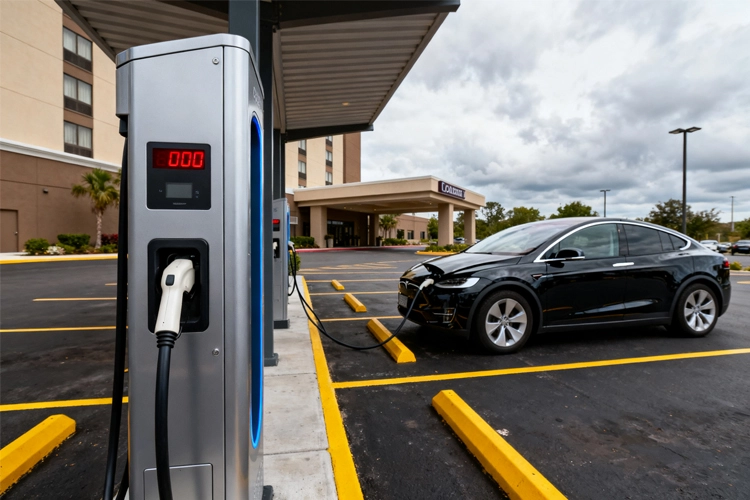
EV drivers demonstrate strong preference behaviors, which significantly influence hotel bookings:
42% of EV guests filter hotels by “EV Charging”
31% are willing to switch hotels—even if the alternative is more expensive
56% of EV travelers check charger availability before arrival
34% specifically avoid hotels that offer only Level 1 charging or slow charging solutions
This behavior is particularly strong among higher-income EV owners—Tesla, BMW, Mercedes EQ, and Lucid drivers—making the availability and type of charging especially important for the luxury hotel segment.
Competitive Advantage for Hotels Offering EV Charging
Hotels equipped with proper EV charging infrastructure enjoy measurable business advantages:
3–7% higher occupancy
Longer average dwell times
Increased F&B revenue (6–23% higher depending on hotel type)
Higher guest loyalty and better review scores
Increased revenue from non-guest charging in high-traffic areas
Hotels that implement a well-designed EV charging strategy—especially those aligned with their guest demographics—see the fastest ROI and strongest competitive differentiation.
Understanding Hotel EV Charging Options
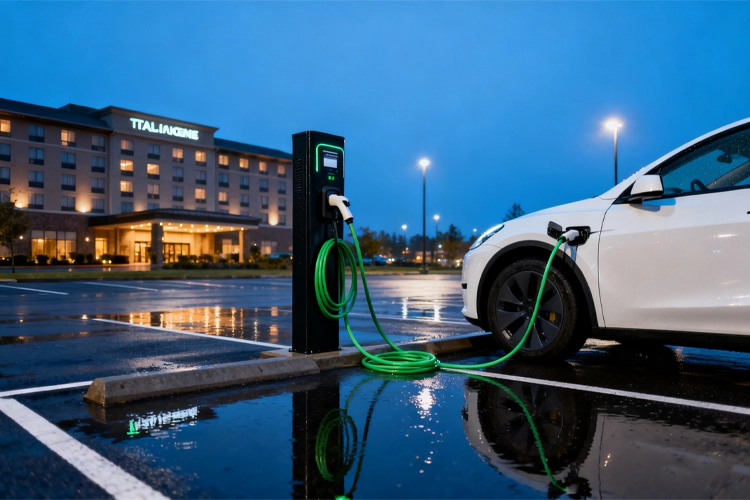
What Is Level 2 Charging? (AC Charging)
Level 2 charging is the most common EV charging option for hotels due to its cost-effectiveness, easy installation, and suitability for overnight stays.
Technical Characteristics
Power levels: 7 kW, 11 kW, 22 kW
Charging time: 4–10 hours for a full charge depending on vehicle and power level
Electrical requirement: 208–240V AC
Charging connectors: Type 2, J1772, GB/T (market dependent)
Расходы на установку
Hardware: $700–$1,600
Installation: $2,000–$6,000
Network setup: $200–$600
Advantages for Hotels
Ideal for overnight guests
Minimal electrical upgrades
Low ongoing costs
Easy to scale horizontally (multiple ports)
Enhances guest satisfaction without disrupting operations
Ideal For
Luxury hotels
Resort hotels
Chain hotels with typical overnight customers
What Is DC Fast Charging (DCFC)?
DC fast charging delivers high-power charging directly to the battery, dramatically reducing charging time.
Technical Characteristics
Power levels: 60 kW, 120 kW, 180 kW, 240 kW, 360 kW
Charging time: 15-45 минут
Electrical requirement: 480V three-phase
Requires high-capacity transformers and utility approvals
Расходы на установку
Hardware: $18,000–$90,000+
Installation: $40,000–$200,000+
Transformer upgrades may add $15,000–$300,000
Advantages
Attracts non-guest EV drivers
Generates significantly higher revenue than Level 2
Ideal for properties near highways or travel corridors
Ideal For
Highway chain hotels
Business hotels in high-traffic areas
Hotels aiming to become public charging hubs
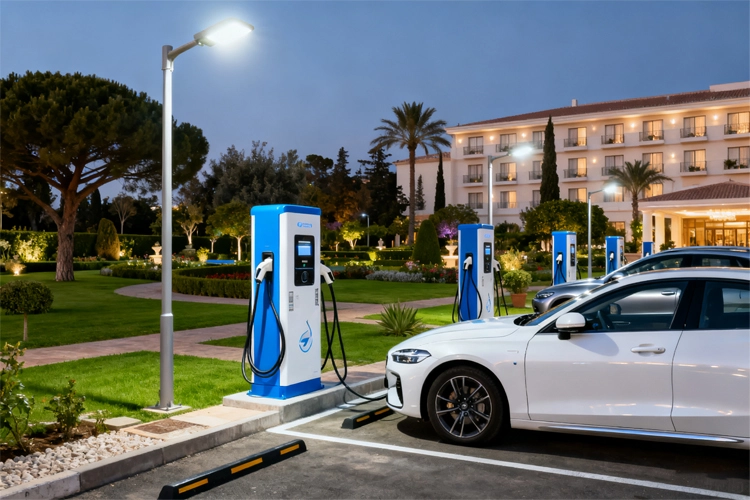
Challenges Hotels Face When Installing EV Chargers
1. Electrical Capacity Limitations
Many hotels lack the spare electrical capacity required for DCFC.
However, a single 120–180 kW DC fast charger may require:
300–500 kW total load support
Major transformer upgrades
This makes Level 2 the more practical solution for most hotels—especially luxury and resort properties located in older buildings or remote areas.
2. Parking Layout & Guest Flow Challenges
Hotels encounter multiple parking management constraints:
87% lack dedicated EV parking capacity
64% struggle with traffic flow congestion
Many guests park for long durations, blocking DCFC turnover
EV charging spaces cannot obstruct valet operations or entrances
Resorts often have large parking lots but long cable runs
These differences affect the optimal charger type depending on the hotel category.
3. High Upfront Costs for DCFC
While Level 2 chargers are typically easy to justify financially, DCFC can strain hospitality budgets:
Level 2 system per port: $3,000–$7,000
DCFC system per station: $65,000–$250,000+
Additional costs:
Trenching & conduit: $20–$80 per foot
Long-distance cable installs (common in resorts)
Annual network & insurance fees
Given these cost layers, DCFC investment must be strategically aligned with hotel type and business model.
4. Regulatory Barriers
Hotels often face:
2–4 weeks for local permitting
1–4 months for utility approvals
Specialized fire codes for electrical rooms
Restrictions in historic or protected buildings (common for luxury hotels)
5. Uncertain ROI
Average monthly revenue (2025):
Level 2: $40–$120 per port
DCFC: $400–$2,400 per station
Payback periods:
Level 2: 18–36 months
DCFC: 4–7 years
But ROI varies dramatically between hotel types—which we will analyze in detail next.
Which Charging Option Fits Your Hotel Type?
A Deep Comparison Across Luxury, Chain, and Resort Hotels**
This is the core of your requested expansion.
Below is a highly detailed, hotel-type–specific analysis with extensive comparison data.
1. Luxury Hotels
(5-star, high-end boutique, premium urban locations)**
Luxury hotels serve a premium clientele that drives higher-end EVs and expects impeccable service quality. Charging solutions must match the brand’s positioning and guest expectations.
Guest Profile
High-income EV owners (Tesla Model S/X, EQS, Mercedes EQ series, BMW i7, Porsche Taycan)
High expectations for convenience & experience
Typically stay 1–3 nights
Expect professionally managed charging, not self-service chaos
More likely to request valet charging or concierge assistance
Charging Needs Analysis
Overnight charging is the primary need
Charging must be quiet, elegant, and integrated into premium parking areas
Must avoid large, visible DCFC equipment disrupting hotel aesthetics
Charging should be part of loyalty or VIP benefits
Guests value reliability more than speed
Best Solution for Luxury Hotels
Primary: Level 2 Charging (11–22 kW)
Matches overnight stay patterns
Lower noise & heat output
Minimal infrastructure and aesthetic impact
Allows hotels to install multiple chargers in VIP parking zones
Great for valet-managed charging
Secondary: 1–2 DC Fast Chargers (120–180 kW)
For VIP guests, business travelers, or concierge-assisted “express charging.”
Recommended Deployment Volume
Ideal deployment model for luxury hotels (make into table)
200+ rooms
8–15 Level 2 chargers
1–2 DCFC for VIP fast charging
Revenue & ROI Considerations
Luxury hotels should prioritize guest satisfaction over raw revenue
Level 2 provides strong ROI with minimal disruption
DCFC ROI depends on whether hotel wants to attract non-guests
Summary for Luxury Hotels
Level 2 is the backbone; DCFC is optional for VIP differentiation.
2. Chain Hotels
(Holiday Inn, Hampton, Marriott Courtyard, Ibis, etc.)**
Chain hotels prioritize efficiency, standardized operations, and cost-effective investments. They serve a wide mix of travelers, including business, highway travelers, families, and overnight guests.
Guest Profile
Mid-income EV drivers
Higher percentages of one-night stays
Mix of highway and urban travelers
Expect dependable charging for practical needs
More price-sensitive than luxury hotel guests
Charging Needs Analysis
Must balance cost and coverage
Need predictable ROI
High turnover means some guests want fast charging
Hotels near highways benefit substantially from DCFC traffic
Best Solution for Chain Hotels
Primary: Level 2 (7–11 kW)
Affordable
Sufficient for overnight guests
Works well with chain hotel operational models
Secondary: 1 DC Fast Charger for Highways or Business Districts
Attracts public charging users
Generates significantly higher revenue
Improves hotel visibility on charging apps (PlugShare, Google Maps, ChargePoint)
Recommended Deployment Volume
Suggested deployment for medium chain hotels (100–200 rooms)
4–8 Level 2 chargers
0–1 DC fast charger depending on traffic volume
Revenue & ROI Considerations
Chain hotels are the most likely to profit from hybrid L2 + DCFC systems
DCFC can turn hotels into local charging hubs
Hotels near highways can achieve ROI of 14–24 months for DCFC
Summary for Chain Hotels
Hybrid systems deliver the best balance of guest satisfaction and revenue generation.
3. Resort Hotels
(Beach resorts, mountain lodges, remote vacation destinations)**
Resort hotels provide extended stays, scenic locations, and a relaxing environment. Guests expect seamless amenities that enhance long-term comfort.
Guest Profile
Longer overall stay duration (2–4 nights)
Families traveling long distances
High likelihood of driving EV to destination
Expect convenience over speed
Less likely to need fast charging
Strategic location usually far from high-power utility lines
Charging Needs Analysis
Overnight and multi-night charging ideal
Level 2 fits long-stay patterns perfectly
DCFC adds little extra value
Resorts often have large parking areas, making L2 scalable
DCFC electrical upgrades are expensive due to remote locations
Best Solution for Resort Hotels
Primary: Level 2 Charging (11–22 kW)
Perfect for multi-day stays
Lower cost makes it easy to install 10–20 ports
Supports all EVs, including rental and guest-owned
Enhances guest satisfaction with minimum investment
Optional: DCFC
Only useful if the resort is on a major travel corridor.
Recommended Deployment Volume
Suggested deployment for resorts with 150–300 rooms
10–20 Level 2 chargers
0–1 DCFC (optional)
Revenue & ROI Considerations
Level 2 ROI is extremely strong due to high utilization
DCFC rarely recovers its cost in resort environments
Guests prefer slow charging because they remain on property for long durations
Summary for Resort Hotels
Level 2 solves 90–95% of charging needs—DCFC usually unnecessary.
EV Charger Deployment Recommendations for Three Hotel Types (Luxury, Chain, Resort)
| Hotel Type | Recommended Number of Level 2 Chargers | Recommended Number of DC Fast Chargers | Primary Use Cases | Target Guest Segments | Power Infrastructure Considerations |
|---|---|---|---|---|---|
| Luxury Hotels | 8–15 units | 4-8 units (120–180 kW) | VIP fast charging + overnight slow charging | High-end EV drivers, premium guests, business travelers | Must avoid negatively impacting hotel aesthetics; prioritize valet areas or designated premium parking zones |
| Chain Hotels | 4–8 units | 3-6 unit (optional) | Mixed use: public charging + overnight guest charging | Business travelers, families, highway transient guests | If located near highways, DC fast chargers are beneficial; typical buildings have moderate electrical capacity |
| Resort Hotels | 10–20 units | 2-4 unit (depending on location) | Primarily overnight/long-stay charging | Family vacationers, long-stay leisure guests | Large parking areas but long cable distances increase installation cost; electrical upgrades often req |
Direct Comparison: Luxury vs. Chain vs. Resort Hotels
Charging Demand Characteristics
| Hotel Type | Stay Duration | EV Guest Behavior | Charger Needs |
|---|---|---|---|
| Luxury | 1–3 nights | Expect premium service, valet charging | Level 2 + VIP DCFC |
| Chain | 1 night | Mix of overnight + highway travelers | Level 2 + optional DCFC |
| Resort | 2–4 nights | Long-stay, relaxed schedule | Level 2 only |
Electrical Infrastructure Feasibility
| Hotel Type | Electrical Upgrade Need | DCFC Feasibility | Notes |
|---|---|---|---|
| Luxury | Medium | Possible but aesthetic concerns | Prefer L2 in valet zones |
| Chain | Средний и высокий | High ROI for highway locations | DCFC works best here |
| Resort | Высокий | Often impractical | Remote areas → costly upgrades |
Recommended Charger Mix
| Hotel Type | L2 Quantity | DCFC Quantity | Rationale |
|---|---|---|---|
| Luxury | 8–15 | 4-8 | VIP experience + overnight charging |
| Chain | 4–8 | 3-6 | Balanced demand + public revenue |
| Resort | 10–20 | 2-4 | Long stays → L2 dominant |
Cost Breakdown for Hotels in 2025
You can use these figures for charts.
Level 2 (per port)
Hardware: $700–$1,600
Construction: $1,200–$3,000
Electrical: $800–$2,500
Network: $200–$600
DCFC (per station)
Hardware: $18,000–$90,000
Construction: $10,000–$40,000
Electrical: $10,000–$80,000
Transformer upgrades: $15,000–$300,000
Installation Roadmap for Hotels
Conduct electrical load study
Identify guest use cases
Select charger mix
Plan parking layout
Submit permitting
Coordinate with utility company
Install & commission
List charging stations on OTA platforms
Promote charging on Google Maps, PlugShare, etc.
Why Hotels Choose Anengjienergy
(Anchor ID: why-choose-anengjienergy)
Anengjienergy provides end-to-end EV charging solutions specifically optimized for the hospitality sector.
Comprehensive Hardware Offering
Level 2 and DC fast chargers
60 kW – 480 kW DCFC options
Built for hotel-grade reliability and outdoor durability
Global Certifications
CE / TUV / CB / CQC / Russian
Compliant with regulations in Europe, South America, Central Asia, Middle East, Russia, Southeast Asia, Asia, Oceania
Advanced Software Platform
Remote monitoring
Smart billing & payment integration
Load balancing
Energy optimization
24/7 uptime management
Multi-Protocol Support
CCS
CHAdeMO
GB/T
Ensures compatibility with all EVs across global regions.
Hotel Case Studies Using Anengjienergy Chargers
Russia – Apartment Hotel (180 kW DCFC)
Achieved full charger utilization due to high public traffic
Added a competitive differentiator within the region
High ROI due to strong commuter demand
Thailand – Beach Resort (120 kW DCFC + Level 2)
Guests stayed longer in F&B areas
Restaurant revenue increased 22%
Improved guest satisfaction ratings
Germany – Business Hotel (180 kW DCFC)
ROI achieved in 11 months
Became a local charging hub for business commuters
Increased Google visibility and booking selection rate
Conclusion: Which EV Charger Is Best for Your Hotel?
Level 2 Is Best When:
Your guests stay overnight
You’re a luxury or resort hotel
You want fast ROI
You need a low-maintenance system
DC Fast Charging Is Best When:
You are near a major highway
You want to attract non-guest revenue
You have strong electrical infrastructure
Final Recommendation
For 80–90% of hotels,
Level 2 provides the best balance of cost, convenience, and ROI.
DCFC is beneficial primarily for highway chain hotels, business districts, or hotels aiming to become public charging hubs.