 Loading ...
How much does it cost to install EV chargers on highways — and how long to break even?
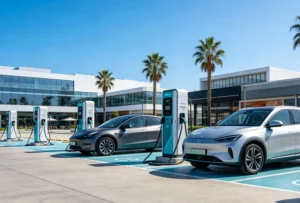
Highway DC fast charging stations are the backbone of long-distance EV travel.
For charging station investors and operators, the most important questions are:
How much does it cost to install EV chargers on highways?
What risks and hidden expenses exist?
How fast can the investment break even (ROI)?
This guide provides a complete breakdown of cost structure, installation challenges, risk control, and realistic ROI analysis — suitable for investors, charge point operators (CPOs), EPC contractors, highway service areas, and fleet hubs.
1. Full Cost Breakdown — Cost to Install EV Charger on Highways
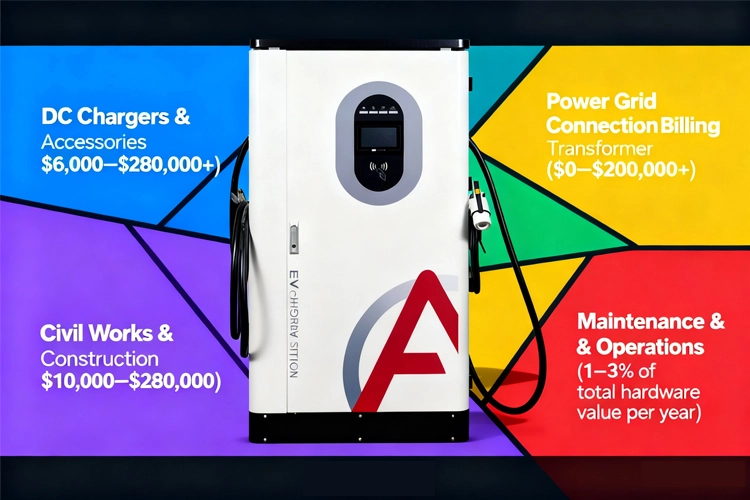
The total cost is driven by 5 major components:
| Cost Category | Typical Range |
|---|---|
| DC Chargers & Accessories | $6,000 – $280,000+ per unit |
| Civil Works & Construction | $10,000 – $200,000 |
| Power Grid Connection & Transformer | $0 – $200,000+ |
| Software & Billing Platform | $500 – $3,000/year |
| Maintenance & Operations | 1–3% of total hardware value per year |
1.1 Charger Hardware Cost
DC fast chargers are required on highways due to high power and turnaround speed.
| Charger Power | Price Range | Use Case |
|---|---|---|
| 60 kW | $6,000 – $10,000 | Small stations / low traffic |
| 120 kW | $8,000 – $22,000 | Standard highway fast charging |
| 180–360 kW | $10,000 – $80,000 | High turnover passenger EV |
| 360–1440 kW (Ultra-Fast) | $80,000 – $280,000+ | Bus/Truck heavy-duty corridors |
✔ Multi-gun chargers increase utilization and profitability
✔ Pricing varies by CCS, CHAdeMO, GB/T, NACS standards
✔ Anengjienergy provides 2-gun / 3-gun / 4-gun configurable fast chargers
1.2 Civil Engineering & Site Construction Costs
Civil works include:
Land leveling & concrete base
Cable trenching, conduits, and ducting
Drainage, lightning protection, fire protection
Lighting and canopies
Parking bay markings
Typical Range: $10,000 – $200,000
Smaller sites cost less; large highway hubs with 6–20 chargers require more complex engineering and traffic layout.
1.3 Power Grid Connection & Transformer Upgrade
| Station Size | Grid Upgrade Needed? | Notes |
|---|---|---|
| <100 kW | Usually no upgrade | Can often directly connect |
| 150–300 kW | Possible cable upgrade | Depends on local grid |
| 300–600+ kW | Transformer upgrade common | New feeder or substation |
| >1 MW | High-voltage access | Suitable for large hubs & trucks |
Typical power upgrade costs:
| Item | Cost Range |
|---|---|
| Transformer (400–1000 kVA) | $50,000 – $200,000 |
| New power line / feeder | $20,000 – $100,000 |
| Grid application & permits | $2,000 – $20,000 |
| Substation / switchgear room | $30,000 – $100,000 |
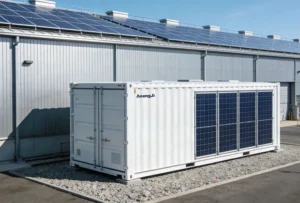
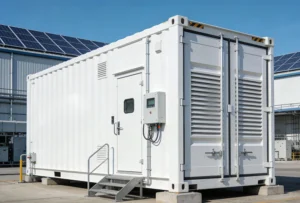
Optional — Energy Storage System (ESS)
To avoid transformer upgrades and peak power costs:
| Battery Storage Size | Approx Cost |
|---|---|
| 100–250 kWh | $30,000 – $80,000 |
| 500 kWh+ | $80,000 – $150,000 |
✔ Reduces peak load
✔ Enables “solar + storage + charging”
✔ Faster project approval in weak-grid areas
1.4 Software, Billing & Management Platform
OCPP 1.6 / 2.0.1 compatible
Remote diagnostics
Multi-operator billing & roaming
Dynamic load management
Fleet billing
Cost: $500 – $3,000/year
1.5 Ongoing Operational Costs
Electricity is the largest expense
Maintenance = 1–3% of equipment cost/year
24/7 monitoring/customer service
Example:
A $200,000 station → $2,000–$6,000 annual maintenance cost
Cost Summary Example
5 × 60 kW chargers (~300 kW total)
➤ Full investment ≈ $90,000 – $150,000 (excluding electricity)
➤ With energy storage and canopies, cost may rise to $180,000 – $240,000
2. Risks & Challenges for Highway Charging Investments
Highway charging is profitable — but only with good planning. Operators must consider:
2.1 Market Risk
❗ EV traffic might be lower than expected
Solution: demand forecasting, competitor analysis, highway usage data
❗ Nearby competitors reduce traffic
Solution: ultra-fast chargers, multi-gun hubs, pricing strategy, convenience retail
2.2 Technical Risk
❗ Power too low → long queues
Use modular chargers (60 → 120 → 180 kW upgradeable)
❗ Interface incompatibility
Multi-standard chargers: CCS / GB/T / CHAdeMO / Tesla / NACS
Anengjienergy offers 3-gun & 4-gun DC chargers with mixed connectors
❗ Poor software → downtime
OCPP cloud platform + remote fault monitoring
2.3 Power Grid Risk
❗ Grid insufficient → project delay or cost explosion
Add ESS to avoid transformer upgrade
Peak-valley electricity arbitrage
2.4 Policy & Permit Risk
Local approval delays
Utility company coordination
Fire safety requirements
Most governments now support EV fast charging with subsidies / low-interest loans.
2.5 Operational Risk
❗ Charger failure → angry customers
24/7 remote monitoring + spare modules
Anengjienergy offers 2-year warranty + on-site support
❗ Long queues reduce customer satisfaction
Multi-gun chargers + reservation system + smart load management
❗ Only charging revenue = slow ROI
Add retail, coffee, parking fees, solar generation
3. Highway Charging ROI Analysis
3.1 Revenue Streams
✔ Charging fees (kWh or time-based)
✔ Parking fees
✔ Retail & food revenue
✔ Advertising
✔ Government subsidies
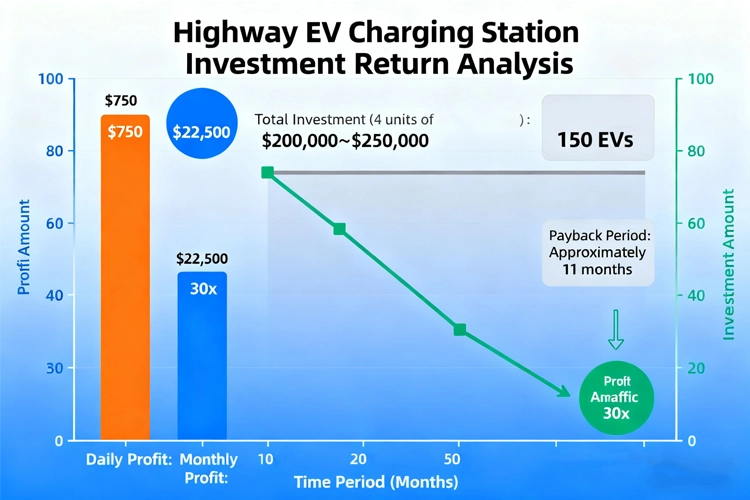
3.2 Realistic ROI Example
| Parameter | Value |
|---|---|
| Station Size | 4 × 120 kW fast chargers |
| Total Power | 480 kW |
| Total Investment | $200,000 – $250,000 |
| Daily traffic | 150 EVs/day |
| Avg charging | 25 kWh/vehicle |
Daily Energy = 150 × 25 kWh = 3,750 kWh
If price = $0.35/kWh
Electricity cost = $0.15/kWh
Daily gross profit
(0.35 – 0.15) × 3,750 = $750/day
Monthly profit
$750 × 30 ≈ $22,500/month
ROI & Payback
$250,000 ÷ $22,500 ≈ 11 months
✔ Higher traffic → faster payback
✔ Truck corridors & bus routes deliver highest ROI
✔ Ultra-fast charging increases turnover and revenue
3.3 Ways to Improve ROI
Add solar + ESS to reduce energy cost
Multi-gun chargers → same space, higher traffic
Offer fleet charging packages
Add retail / café / vending machines
Participate in roaming networks (Plugshare, ChargePoint, etc.)
4. Why Partner With Anengjienergy
✔ Turnkey EPC solution — design + supply + installation + software
✔ CCS2, CCS1, CHAdeMO, GB/T, NACS compatible
✔ 60–600 kW DC chargers / multi-gun / liquid-cooled ultra-fast charging
✔ Cloud OCPP billing platform
✔ Global shipping + engineering support
✔ 24/7 service + spare parts supply
5. Get a Customized Cost & ROI Proposal
Want to calculate the cost to install EV chargers on your highway location?
We provide:
Power evaluation + transformer sizing
Full cost breakdown
ROI forecast & revenue model
Turnkey installation & commissioning
Solar + storage integration (optional)
📩 Contact Anengjienergy to get a custom quote and ROI calculation