Introduction
Electric vehicles (EVs) are redefining the global automotive landscape, representing a major shift toward sustainable, low-emission transportation. By relying on electric power rather than traditional fossil fuels, EVs help reduce greenhouse gas emissions and air pollution—making them an attractive option for environmentally conscious consumers in regions such as Europe, Asia, the Middle East, and Central Asia.
At the heart of EV usability lies one essential question: how long does it take to charge an electric vehicle? Understanding charging time is critical for drivers and businesses planning EV adoption. Factors like battery capacity, charger type, and charging infrastructure play key roles in determining how long a vehicle needs to recharge.
For fleet operators, investors, and EV owners, this guide explains everything about EV charging time—from types of chargers to technological advances and regional infrastructure growth.
Current Electric Vehicle Market Overview
The electric vehicle market continues to grow rapidly across Europe, Asia, and the Middle East, fueled by environmental policies and government incentives. According to international statistics, over 10 million EVs were sold globally in 2022, marking a strong upward trend.
There are three major types of EVs:
Battery Electric Vehicles (BEVs) – 100% electric, no fuel engine.
Plug-in Hybrid Electric Vehicles (PHEVs) – electric motors with backup fuel engines.
Fuel Cell Electric Vehicles (FCEVs) – powered by hydrogen technology.
Countries such as Norway, China, and the UAE lead in EV adoption due to strong government incentives and dense charging networks. Meanwhile, Central Asian and Southeast Asian nations are accelerating infrastructure growth through new investments in commercial charging stations and DC fast charging networks.
➡️ Internal link suggestion: Learn more about Commercial EV Charging Solutions
Types of EV Charging Stations and Their Impact on Charging Time
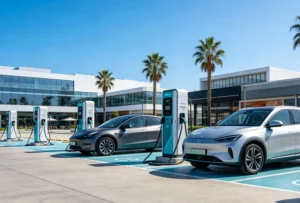
EV charging stations are generally classified into three categories — Level 1, Level 2, and DC Fast Charging. Each serves a different purpose and determines how long it takes to charge an EV.
Level 1 Charging
Uses a standard 120V outlet
Adds 2–5 miles of range per hour
Best suited for home charging overnight
➡️ Internal link suggestion: Explore Home EV Chargers
Level 2 Charging
Operates at 240V
Adds 10–60 miles of range per hour
Common in workplaces, apartments, and public parking areas
DC Fast Charging (Level 3)
Provides 100–350 miles of range in 30 minutes
Ideal for highways, commercial hubs, and long-distance drivers
Uses 400–800V high-voltage systems for ultra-fast charging
➡️ Internal link suggestion: Discover DC Fast Charging Stations
These categories highlight how charging speed varies by infrastructure type—a crucial factor for both individual EV owners and fleet operators in regions like Europe and Central Asia, where long-distance driving is common.
Factors Affecting EV Charging Time
The time required to fully charge an EV depends on several key elements:
Battery Capacity (kWh) – Larger batteries (80–100 kWh) take longer to charge than smaller ones (30–50 kWh).
State of Charge (SoC) – A nearly empty battery takes longer to recharge than one already at 50%.
Charger Output Power – A 1.4 kW home charger vs. a 350 kW fast charger can mean hours vs. minutes of charging time.
Temperature and Environment – Extreme heat or cold can affect charging efficiency.
Vehicle Model and Technology – Different EVs have varying energy management systems and battery chemistries.
Understanding these factors helps users plan efficient charging schedules and choose appropriate infrastructure for their region and usage pattern.
Case Studies: Charging Time Comparison Across EV Models
Different EV models demonstrate the wide range of possible charging durations:
Tesla Model 3 (82 kWh battery)
~30 minutes to 80% with a Supercharger (DC fast)
~10 hours for full charge with a Level 2 home charger
Chevrolet Bolt (66 kWh)
100 miles in 30 minutes with fast charging
Up to 14 hours with Level 1 home charger
Ford Mustang Mach-E (100 kWh)
Gains 61 miles in 10 minutes with ultra-rapid charging
10 hours for full charge on a Level 2 public charger
These examples illustrate how charging speed depends heavily on both the infrastructure type and the vehicle’s battery size.
➡️ Internal link suggestion: Learn more about EV Charger Compatibility and Standards
Technological Advancements in EV Charging
Charging technology continues to evolve rapidly, especially in Europe and Asia, where infrastructure investment is expanding.
Ultra-Fast Charging
Recharges up to 80% in 15–30 minutes
Becoming standard on new EV networks and expressways
Wireless Charging
Uses electromagnetic induction for cable-free charging
Ideal for public parking lots, taxis, and fleet depots
Solid-State Batteries
Offer higher energy density and faster charge rates
Expected to cut charging time by 50% or more in the next decade
Together, these innovations aim to make EV ownership more practical for regions with long travel distances like Russia, the Middle East, and Central Asia.
The Role of Charging Infrastructure in Regional Development
A strong charging infrastructure is essential to accelerating EV adoption. Governments and private companies are investing heavily across Europe, Asia, and the Middle East to expand public fast-charging networks.
European Union programs fund cross-border charging corridors.
GCC countries (UAE, Saudi Arabia) are installing nationwide DC charging hubs.
Kazakhstan and Uzbekistan are developing commercial EV charging networks for regional logistics.
Private partnerships also drive innovation with smart charging apps, payment systems, and energy-efficient hardware.
These combined efforts will reduce charging times, enhance accessibility, and promote confidence in electric mobility infrastructure.
Consumer Charging Behavior and Habits
Consumer behavior directly affects how long EVs take to charge in practice. Most EV owners prefer home or workplace charging, often overnight or during off-peak electricity hours.
In urban areas, public fast-charging stations serve apartment dwellers and taxi fleets. In Central Asia and the Middle East, businesses are deploying commercial charging hubs to meet fleet and tourism demand.
Consumers also adapt their charging habits according to:
Daily mileage and commute distance
Electricity costs and time-of-use rates
Regional infrastructure availability
The more consistent and well-planned the charging routine, the less “waiting time” becomes a concern.
Future Market Estimates for Charging Time
Looking ahead, industry experts predict that charging times will continue to drop sharply.
Emerging trends include:
Solid-state battery adoption → full charge in under 15 minutes
Higher-capacity DC chargers (up to 500 kW)
AI-powered charging management for efficiency optimization
As charging networks expand across Europe, Asia, and the Middle East, consumers can expect faster, more reliable, and more accessible EV charging options than ever before.
Conclusion
Charging time is one of the most critical aspects of the EV ownership experience. With technological innovation, government investment, and growing private-sector participation, the EV charging ecosystem across Europe, Asia, Central Asia, and the Middle East is evolving rapidly.
From home chargers to ultra-fast commercial stations, the future of EV charging is not just about speed — it’s about accessibility, reliability, and sustainability.
➡️ Internal link suggestion: Contact us to explore Customized EV Charging Solutions for Your Region