Introduction
In the volatile energy landscape of 2026, implementing a battery energy storage system for manufacturing plants has shifted from a “sustainability luxury” to a fundamental economic necessity. As global electricity markets face unprecedented fluctuations and industrial power grids struggle with the integration of intermittent renewables, factories are increasingly turning to advanced storage solutions to safeguard their operations. A well-engineered industrial BESS solution for factories does more than just provide backup power; it acts as a sophisticated energy buffer that optimizes consumption patterns, slashes peak demand charges, and ensures that precision manufacturing lines remain immune to the micro-fluctuations that characterize modern aging grids.
Energy Challenges in Industrial Manufacturing and Why BESS Is Needed
The industrial sector is currently facing a “perfect storm” of energy-related headwinds. As we move deeper into 2026, the traditional model of relying solely on the utility grid is proving both risky and expensive for high-output facilities.
Rising Electricity Costs in Manufacturing Facilities
Global energy prices have seen a structural shift upward. According to the IEA World Energy Outlook 2025, industrial electricity rates in key manufacturing hubs have risen by an average of 18% over the past two years. For energy-intensive sectors like automotive, chemicals, and electronics, these costs directly erode profit margins, making an industrial battery storage system a high-priority investment.
Peak Demand Charges and Energy Cost Pressure
Utility companies don’t just charge for total energy used (kWh); they charge heavily for the maximum power drawn at any single moment (kW). These “demand charges” can account for up to 50% of a factory’s monthly bill. Without a peak shaving energy storage strategy, a single 15-minute spike in production can result in thousands of dollars in penalties.
Power Instability and Production Downtime Risks
Modern manufacturing relies on sensitive CNC machines, robotics, and cleanroom environments. Even a voltage sag lasting less than 100 milliseconds can trigger a safety shutdown, leading to hours of recalibration and scrapped materials. An industrial power backup system integrated into a BESS provides the sub-cycle response time needed to prevent these catastrophic losses.
Renewable Energy Integration Challenges in Factories
Many forward-thinking plants have installed rooftop solar, but the mismatch between peak solar generation (noon) and peak industrial load (morning/evening) leads to wasted energy. Solar plus BESS for industrial manufacturing solves this by capturing surplus green energy for use during expensive peak hours.
What Is BESS for Industrial Manufacturing?
Definition of Battery Energy Storage System (BESS)
At its core, a battery energy storage system (BESS) is an electrochemical asset designed to decouple energy generation from energy consumption. Unlike traditional UPS systems designed only for short emergencies, an industrial-grade BESS is a “workhorse” designed for daily cycling, high-power throughput, and intelligent grid interaction.
How BESS Works in Industrial Manufacturing Facilities
The system operates by storing electricity—either from the grid during off-peak hours (when prices are low) or from on-site renewables—and discharging it when demand spikes or prices rise. This process is managed by sophisticated power electronics that ensure the transition is seamless to the factory’s machinery.
Key Components of Industrial BESS Systems
A robust commercial and industrial ESS consists of four critical engineering layers:
- Battery System: Typically utilizing Lithium Iron Phosphate (LFP) for its superior thermal stability and 6,000+ cycle life, or the emerging Sodium-ion chemistry for cost-sensitive, wide-temperature applications.
- Power Conversion System (PCS): The bi-directional inverter that converts DC battery energy to AC factory power. High-end PCS units now offer “grid-forming” capabilities.
- Battery Management System (BMS): The low-level electronics that monitor individual cell voltage, temperature, and State of Health (SoH).
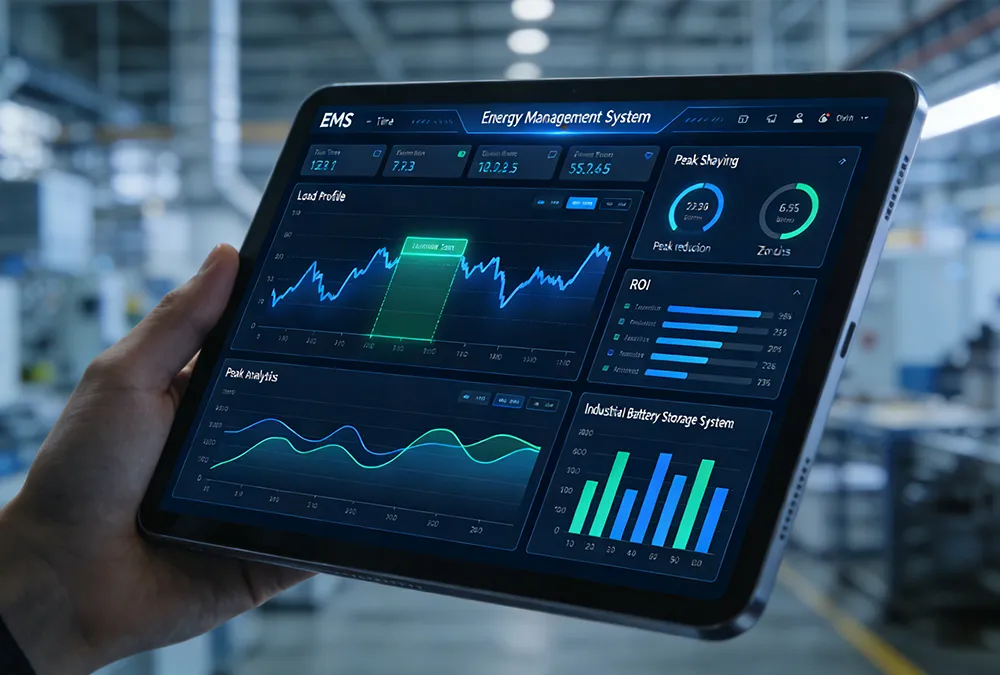
- Energy Management System (EMS): The high-level “brain” that executes algorithms for peak shaving, arbitrage, and load forecasting.
Benefits of BESS for Industrial Manufacturing
The ROI for a battery energy storage system for manufacturing plants is no longer a theoretical projection; it is a data-driven certainty.
Reduce Electricity Costs with Peak Shaving and Load Shifting
By discharging stored energy during peak production periods, the system “shaves” the top off the facility’s demand profile. This directly lowers the demand charges billed by the utility. Furthermore, “load shifting” allows the plant to buy energy at night (cheap) and use it during the day (expensive).
Improve Power Reliability and Prevent Production Losses
In the event of a grid failure, the BESS provides an instantaneous transition to “island mode.” For a pharmaceutical plant or a semiconductor fab, this reliability is the difference between a normal workday and a multi-million dollar loss.
Enable Energy Arbitrage and Lower Operating Expenses
In 2026, many energy markets offer “Time-of-Use” (ToU) pricing. An industrial energy management system uses AI to predict price fluctuations on the wholesale market, charging the battery when prices are near zero (or even negative during renewable surges) and discharging when rates are highest.
Support Sustainability and Carbon Reduction Goals
A BESS increases the “self-consumption” rate of on-site solar. By reducing reliance on the carbon-heavy evening grid, factories can meet stringent ESG (Environmental, Social, and Governance) targets and avoid potential carbon taxes.
How BESS Improves Energy Efficiency in Industrial Manufacturing
Smart Energy Scheduling with EMS
Modern EMS platforms use machine learning to analyze historical load data and weather forecasts. This allows for energy storage for factories to be scheduled with surgical precision, ensuring that the battery is never empty when a peak load is expected.
Optimizing Load Profiles in Manufacturing Plants
By smoothing out the erratic power draw of heavy machinery (like arc furnaces or large motor starts), a BESS improves the overall power factor of the plant, reducing strain on internal transformers and switchgear.
Integration with Solar Energy Systems in Factories
When a factory energy storage solution is paired with a PV array, it transforms the facility into a semi-autonomous microgrid. Surpluses are no longer exported to the grid for pennies; they are stored to offset the most expensive electricity of the day.
Real Applications of BESS for Industrial Manufacturing
BESS for Heavy Manufacturing Plants (Steel, Cement, Chemicals)
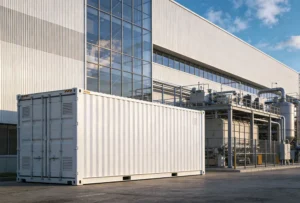
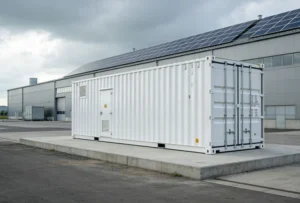
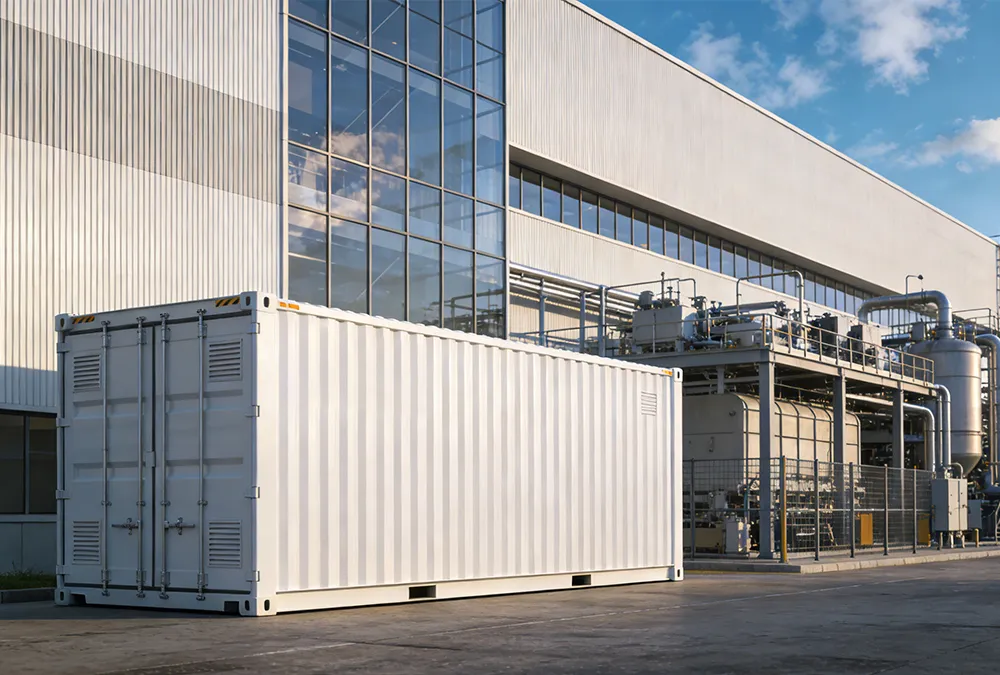
These facilities have massive, highly variable loads. A containerized BESS for industry (typically 2MWh to 10MWh units) can buffer the surge current of massive kilns or grinders, preventing voltage dips that affect neighboring equipment.
Energy Storage for Electronics and Precision Manufacturing
In these environments, “Power Quality” is more important than “Power Quantity.” A BESS acts as a massive active filter, removing harmonics and transient spikes from the grid supply.
BESS for Industrial Parks and Microgrids
Multi-facility sites can share a centralized industrial microgrid system. This allows for the aggregation of demand, where the BESS supports whichever facility is peaking at a given moment, maximizing the utilization of the battery asset.
BESS Integrated with EV Charging in Industrial Facilities
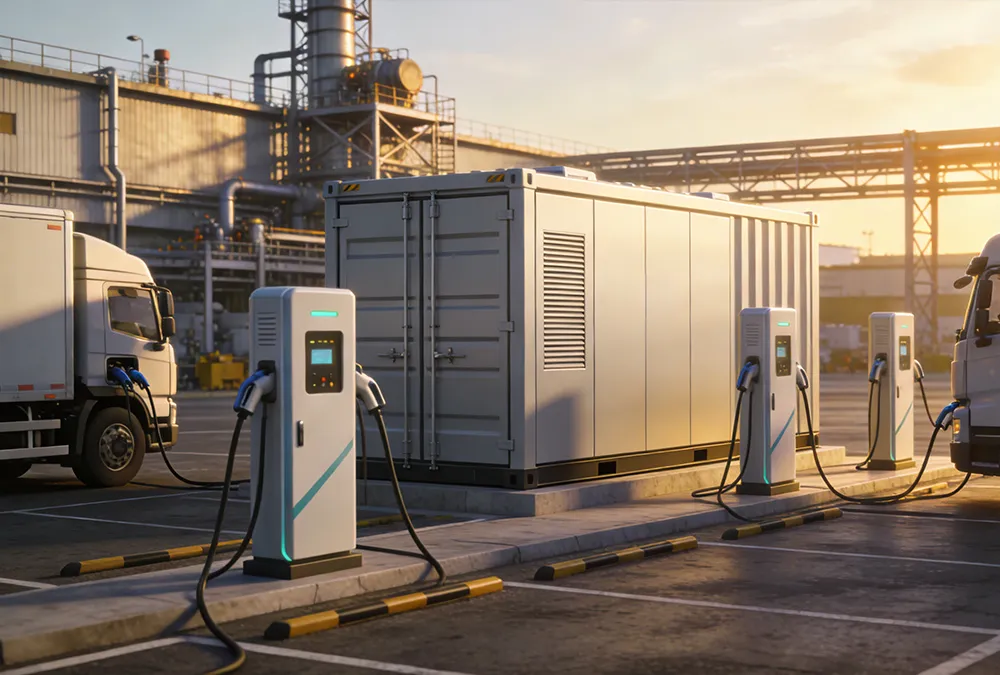
As factory fleets go electric, the demand for high-speed DC charging can overwhelm the local transformer. Integrating a lithium battery for industrial use allows for 250kW+ charging speeds without requiring a multi-million dollar grid upgrade.
BESS for Industrial Peak Shaving and Demand Charge Reduction
How Peak Shaving Works in Industrial BESS
Imagine a factory with a steady 500kW load that spikes to 800kW every time a specific heavy compressor kicks in. Without a BESS, the utility bills you for an 800kW peak. With a BESS for industrial peak shaving, the battery provides that extra 300kW for the duration of the spike, and the utility only sees a flat 500kW line.
Reducing Demand Charges for Manufacturing Plants
| Cost Component | Without BESS | With BESS (Peak Shaving) | Savings |
| Peak Demand (kW) | 1,200 kW | 900 kW | 300 kW |
| Demand Rate ($/kW) | $20 | $20 | – |
| Monthly Demand Charge | $24,000 | $18,000 | $6,000 |
| Annual Savings | – | – | $72,000 |
Note: Data based on typical 2025/2026 North American and European industrial utility tariffs.
Case Example of Cost Savings Using BESS
A medium-sized plastics extrusion plant in Poland installed a 500kWh industrial energy storage system in late 2025. By shaving just 150kW off their monthly peak and shifting 300kWh of daily consumption to off-peak hours, they reduced their annual energy spend by $84,500, targeting a full payback in just 3.8 years.
Industrial BESS System Design and Configuration
How to Size BESS for Industrial Manufacturing
Sizing a battery energy storage system for manufacturing plants requires more than just looking at the monthly bill. It requires a high-resolution load profile (1-minute or 15-minute intervals).
- Power (kW): Determined by the size of the peaks you want to shave.
- Energy (kWh): Determined by how long those peaks last and how much load you want to shift.
H3: Matching PCS Capacity with Factory Load
The PCS must be able to handle the inrush currents of the factory’s largest motors. A common mistake is undersizing the inverter (PCS), leading to system trips when heavy machinery starts.
Role of EMS in Industrial Energy Storage Optimization
The EMS is the software layer that makes the hardware profitable. It must support OpenADR or similar protocols for “Demand Response” programs, where the utility pays the factory to discharge its battery to help the grid.
Safety and Intelligent Management in Industrial BESS Systems
Advanced Battery Safety Systems (Fire Protection, Thermal Management)
Modern energy storage for industrial facilities cost calculations must include high-end safety features. We utilize liquid-cooling systems that maintain cell temperature within a 3°C variance, virtually eliminating the risk of thermal runaway. Furthermore, per-module aerosol fire suppression is now an industry standard.
Smart Monitoring with BMS and EMS Integration
Cloud-based monitoring allows our engineers to perform “Predictive Maintenance.” If a single cell in a 1MWh system shows an abnormal impedance rise, it can be flagged for replacement before it causes a system shutdown.
AI-Driven Energy Management for Industrial Manufacturing
AI algorithms now perform “Degradation-Aware Dispatch.” The EMS chooses whether to participate in a grid event based on whether the payment justifies the small amount of wear and tear on the battery cells.
Cost and ROI of BESS for Industrial Manufacturing
The energy storage system for industrial facilities cost has stabilized in 2026, making the financial case clearer than ever.
Industrial BESS Cost per kWh
In 2026, a fully installed, containerized industrial BESS typically ranges from $280 to $450 per kWh, depending on the power-to-energy ratio and the complexity of the integration.
CAPEX Breakdown of Industrial Energy Storage Systems
- Battery Modules: 50-60%
- PCS / Inverters: 15-20%
- EMS & Controls: 5-10%
- Balance of System (BOS) & Installation: 15-20%
ROI and Payback Period for Manufacturing Facilities
Most energy storage integration for factories projects currently achieve a payback period of 3 to 5 years.
- Direct Savings: Reduced demand charges and ToU arbitrage.
- Indirect Savings: Avoided production downtime and extended equipment life.
- Incentives: Many regions now offer a 30% tax credit or direct grants for industrial decarbonization.
Challenges of Implementing BESS in Industrial Manufacturing
High Initial Investment
Despite the falling costs, the upfront CAPEX for a multi-megawatt system remains significant. However, “Energy-as-a-Service” (EaaS) models are emerging, allowing factories to install a BESS with zero down payment.
System Integration Complexity
Integrating a BESS with existing building management systems (BMS) and aging switchgear requires specialized engineering expertise to ensure protection coordination is maintained.
Regulatory and Grid Connection Requirements
Navigating the “Grid Code” for interconnecting a large battery can be time-consuming. It is essential to work with a partner who understands the local utility’s technical requirements for anti-islanding and reactive power support.
Future Trends of BESS for Industrial Manufacturing
Growth of Industrial Energy Storage Systems
By 2030, we expect over 60% of all new industrial construction to include a BESS as standard equipment. The market for industrial BESS solution for factories is projected to grow at a 30% CAGR through the end of the decade.
Integration of Renewable Energy in Manufacturing
The “Net Zero Factory” is becoming a reality. We are seeing a move toward 100% on-site renewable matching, where the BESS bridges the gap during winter months or cloudy days.
Smart Factories and Energy Digitalization
As Industry 4.0 matures, energy data will be just as important as production data. The BESS will become a “digital asset” that trades energy autonomously on the blockchain-based smart grids of the future.
FAQ: BESS for Industrial Manufacturing
What is BESS for industrial manufacturing?
A battery energy storage system for manufacturing plants is a large-scale electrochemical system used to store grid or solar electricity. It helps factories reduce energy costs through peak shaving and provides a critical power backup for sensitive production lines.
How does BESS reduce energy costs in factories?
BESS reduces costs primarily through peak shaving (lowering demand charges), load shifting (buying cheap night power for day use), and participating in grid-utility incentive programs.
Is BESS suitable for all manufacturing plants?
While most benefit, it is especially profitable for facilities with high energy consumption, variable loads (heavy machinery starts), or those located in regions with high peak demand charges.
What is the ROI of BESS for industrial manufacturing?
Typically, the payback period is between 3 and 5 years. This is driven by direct electricity bill savings and the prevention of costly production downtime caused by power quality issues.
How do you size a BESS for a factory?
Sizing requires a detailed “Load Profile Analysis.” We examine your peak kW demand and your hourly kWh consumption to determine the ideal balance between power capacity and energy duration.
Are you ready to protect your production lines and slash your energy overhead? Our engineering team specializes in the design and deployment of the battery energy storage system for manufacturing plants.
[Contact us today for a complimentary Energy Audit and BESS ROI Simulation.]