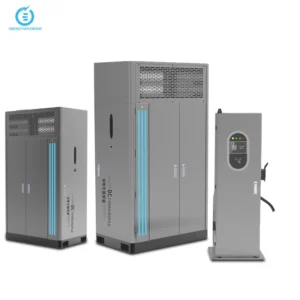
The flexible chargings stack centrally manages all charging power and flexibly allocates the number of charging modules according to actual needs, thereby meeting the high-rate charging needs of different models and batteries.
The 480kw to 1000kw flexible chargings stack has functions such as high power output, fast charging, and large-capacity energy storage, and is suitable for large-scale charging needs, such as large parking lots, enterprises or charging stations.
The flexible charging stack is a power supply cluster that needs to be equipped with corresponding charging piles as output terminals.
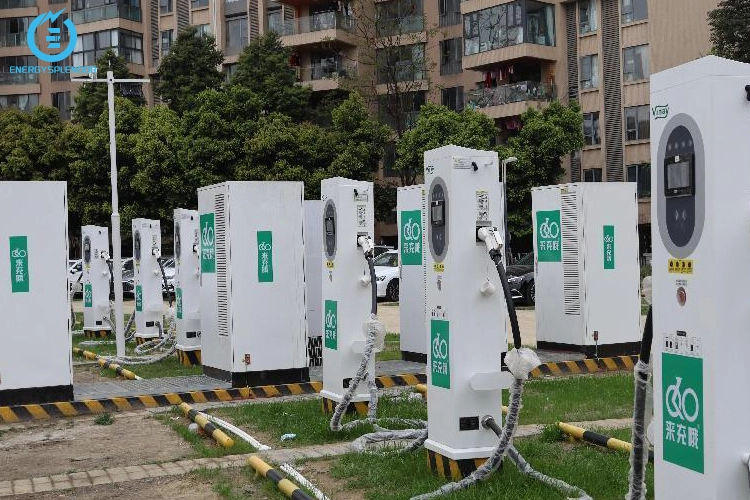
EVMS EV Charging Stack (EV Power Unit + EV Charger Posts)
EV charging stations arranged in a charging stack configuration. This setup typically includes EV power units and EV charger posts. Here’s a breakdown of the components:
EV Power Units: These are the central units that manage power distribution to the charging posts. They handle the conversion of electrical power and ensure the safety and efficiency of the charging process.
EV Charger Posts: These are the physical charging points where electric vehicles plug in to charge. Each post is equipped with a connector compatible with the vehicle’s charging port.
The configuration shown allows for multiple vehicles to charge simultaneously, offering high availability for public charging stations, especially in areas with high EV adoption. The modular design of the stack ensures scalability, meaning more posts can be added as demand grows. The user-friendly interfaces on the posts help drivers easily access and monitor their charging process.
This setup is ideal for urban areas, commercial parking lots, and public charging hubs, where space efficiency, fast charging, and scalability are key.
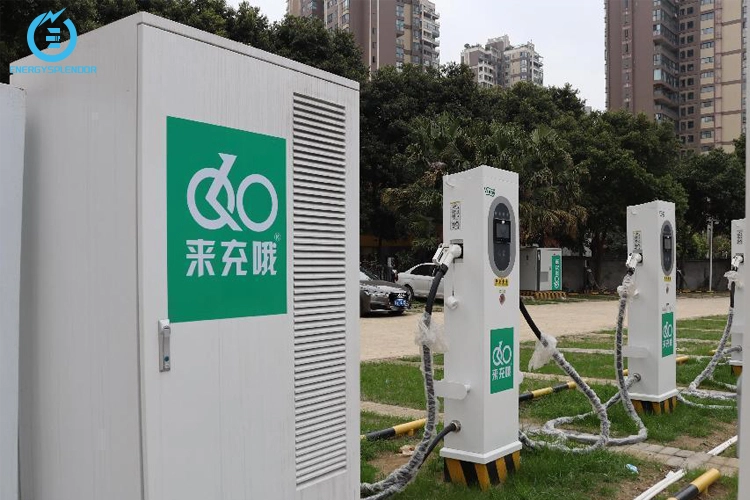
Flexible Charging Stack: Adapting EV Charging
This flexible configuration allows for the scalability of charging stations, making it easy to add more charger posts as demand grows, while centralizing power management in the EV power unit. The charger posts are designed to accommodate various types of electric vehicles, ensuring high compatibility.
Ideal for commercial or public charging stations, this stacked arrangement maximizes space and accessibility. The modular design ensures that as more vehicles are added to the grid, the system can be expanded with minimal hassle, providing a cost-effective solution for high-demand charging environments.
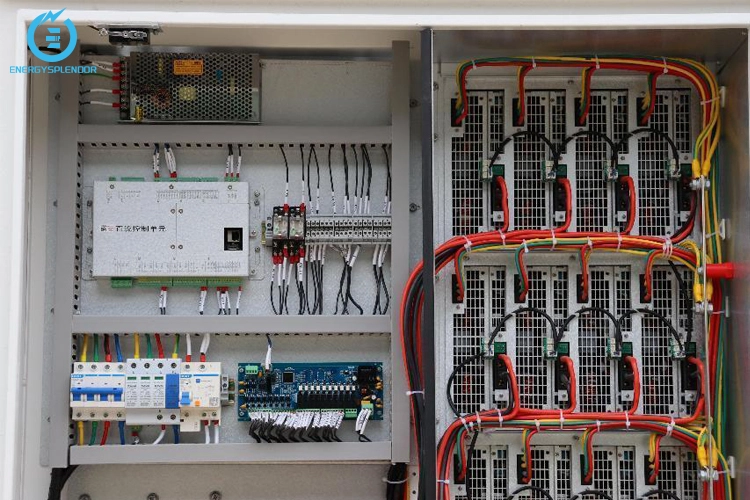
Internal structure of Flexible Charging Stack
The internal structure of a Flexible Charging Stack designed for high-capacity DC EV charging.
Power Supply Units: The top section contains power supply modules that handle the input and output of electrical energy. These modules convert AC to DC to ensure efficient charging of electric vehicles.
Control System: The middle section houses the control board and communication interface for monitoring and controlling the charging process. This system ensures that the charging operation is safe, efficient, and compatible with various EV models.
Distribution and Protection: The lower part includes various circuit breakers, fuses, and overcurrent protection systems, ensuring that the system operates safely and reliably. These components protect against electrical faults and ensure that the correct amount of power is distributed to each charging post.
Modular Design: The stack features a modular design, where multiple charging modules are integrated into a single unit, making the system scalable. Each module works independently, offering high flexibility and allowing the system to be expanded as demand grows.
This internal structure demonstrates how a DC flexible charging stack can effectively handle high power loads while maintaining flexibility and safety for large-scale EV charging operations.

Custom Flexible Charging Stack
A Custom Flexible Charging Stack is designed to meet the specific needs of electric vehicle (EV) charging stations, offering scalability, efficiency, and adaptability. This modular system integrates multiple charging modules to provide the required power output for a variety of vehicles, while maintaining flexibility in terms of installation and future expansion.
Key Features of a Custom Flexible Charging Stack:
Modular Design
The system is built with modular components, allowing you to adjust the number of charging modules based on the specific needs of your location. As demand for EV charging grows, additional modules can be added without needing a complete system overhaul.
Scalable Power Output
Whether you’re operating a small facility or a high-traffic charging hub, a customizable flexible charging stack can support various power levels (e.g., DC 720kW or more) to cater to different types of EVs, including passenger vehicles, buses, and trucks.
AC to DC Conversion
The stack efficiently converts AC to DC power, providing fast and reliable charging for electric vehicles. This conversion ensures that EVs receive optimal charging without energy losses, making it an ideal solution for both commercial and residential use.
Remote Monitoring and Control
Equipped with advanced control systems and Wi-Fi connectivity, the charging stack allows remote monitoring of the charging process. This includes real-time diagnostics, system status updates, and usage tracking through a smartphone app or web interface.
Safety and Protection
Integrated safety features such as overcurrent protection, voltage regulation, and short-circuit protection ensure the system operates safely, preventing electrical faults or damage to the vehicles and equipment.
Custom Branding and Design
The charging stack can be fully customized to match your branding, including custom colors, logos, and packaging. This is especially useful for businesses that want to promote their brand while offering high-quality EV charging services.
Flexible Installation
The custom stack can be installed in various environments, including outdoor parking lots, shopping centers, office buildings, and public spaces. Its compact and modular design makes it easy to fit into different areas and maximize space utilization.
Future-Proof Technology
The custom flexible charging stack is designed to support future EV standards, making it an investment that remains relevant as technology evolves and new vehicle models enter the market.
This customizable solution ensures that EV charging infrastructure meets the growing demand for electric vehicle adoption, providing a high-performance, scalable, and branded solution for charging stations.
We integrated a flexible charging stack solution into our EV charging system, and it has brought exceptional scalability and efficiency. The modular design allows us to easily adjust power output based on real-time demand, optimizing energy usage while supporting multiple EVs simultaneously. Its compact structure saves space, and the plug-and-play integration significantly reduces installation and maintenance time. The system runs stably under various operating conditions and offers intelligent load balancing, which has greatly improved our charging station performance. This flexible charging stack has made our infrastructure smarter, more efficient, and ready for future expansion.
We integrated a flexible charging stack system into our EV charging station, and the results have been outstanding. The modular design allows us to scale power output based on demand, which has significantly improved energy efficiency and reduced wait times. The system supports multiple charging guns with smart load balancing, enabling us to serve more vehicles at once without compromising performance. It’s also easy to maintain and expand as our needs grow. Since upgrading to the flexible charging stack, our station has become more reliable, future-proof, and customer-friendly. Highly recommended for commercial EV charging projects.
We upgraded our EV station with a flexible charging stack, and the improvement has been significant. The system automatically adjusts power distribution based on real-time demand, allowing us to charge multiple vehicles efficiently without overloading. It’s scalable, easy to maintain, and future-proof — exactly what we needed as usage increased. The modular design also makes it easy to expand without disrupting daily operations. Since the installation, both performance and customer satisfaction have improved noticeably. This charging stack solution has made our station smarter, more reliable, and better prepared for the growing EV market.
We deployed the DC 480kW flexible charging stack at our highway charging site, and the results have been excellent. The system supports simultaneous fast charging for multiple EVs without compromising speed or stability. Its modular design makes it easy to scale and maintain, and the intelligent load distribution ensures optimal energy use during peak hours. Even under high traffic conditions, the charging process remains smooth and reliable. Our team and customers have noticed a big improvement in efficiency and service quality. This 480kW stack is a powerful and future-ready solution for high-demand charging environments.
We integrated a Two-way Flexible Charging Stack into our EV infrastructure, and it has exceeded expectations. The system not only delivers high-efficiency fast charging but also supports vehicle-to-grid (V2G) energy feedback, giving us more control over power flow and grid support. Its modular and bidirectional design allows for dynamic power management, making it ideal for smart energy applications and peak shaving. The setup is scalable, easy to maintain, and provides excellent performance in both charging and discharging modes. It’s a forward-thinking solution that adds flexibility, efficiency, and long-term value to our EV charging operations.
We recently installed the 720kW liquid-cooled super fast EV charging stack at our expressway charging hub, and the performance is outstanding. It handles ultra-high power delivery with incredible stability, allowing multiple EVs to charge simultaneously at top speed. The liquid-cooling system keeps temperatures in check even during continuous operation, ensuring long-term reliability and safety. Its modular design makes maintenance simple, and the fast response time improves the entire user experience. For high-traffic locations needing ultra-fast, scalable EV charging, this 600/720kW system is a game-changer. We’re very satisfied with its efficiency, power, and future-ready design.
What Is Flexible Charging?
Flexible charging refers to EV charging systems that can dynamically adjust power, charging modes, or configurations based on real-time needs, user preferences, or grid conditions. It enhances efficiency, reduces costs, and improves compatibility with different EVs and environments.
Charging stations can automatically or manually change output power (e.g., 30kW, 60kW, 120kW) depending on:
Number of vehicles connected
Battery SOC (State of Charge)
Grid load conditions
💡 Example: A 240kW station distributes 120kW to one EV, and if a second EV connects, it may split to 120kW + 120kW or 90kW + 150kW.
Multiple charging guns share one power module stack, allowing intelligent power allocation.
Ideal for fleet depots, commercial plazas, or highway stations.
💡 Flexible charging stacks can connect 2–6 dispensers dynamically to optimize usage.
Use of modular power units (e.g., 15kW/30kW modules) allows chargers to scale output up/down or perform hot-swap maintenance without shutting down the entire system.
Works with demand response systems, adjusting power output based on electricity prices or peak hours to lower operational costs.
💡 Flexible charging can pause or slow down during grid stress, and ramp up when energy is cheaper.
⚡ Faster charging based on available capacity
🔄 Multi-vehicle charging with intelligent power distribution
💰 Lower infrastructure costs (one power cabinet, multiple terminals)
🔌 Compatibility with more EV types (e.g., trucks, buses, passenger cars)
🌍 Energy efficiency and better grid integration
Flexible charging is a smart EV charging approach that allows adaptive power control, shared usage, and modular scalability, making it ideal for modern, high-demand EV infrastructure — especially for public fast-charging stations, fleet depots, and energy-conscious operators.
In the context of a Flexible Charging Stack, a Mode 2 Flexible Charger refers to a distributed DC fast charging terminal that operates as a satellite (or slave) unit, drawing dynamic power from a centralized master power cabinet. It is not a standalone charger and does not contain power modules inside. Instead, it connects to the central charging stack, allowing multiple charging terminals to share and dynamically allocate power.
Main Power Cabinet (Charging Stack Core)
Houses multiple 30kW/40kW DC charger modules
Centralized power source for several terminals
Total output: 240kW, 480kW, 600kW, 720kW, etc.
Mode 2 Flexible Charger (Distributed End Terminal)
Wall-mounted or pedestal-type DC output unit
Compatible with CCS2, GBT, CHAdeMO, or Type 2
Connects to the main cabinet via power and control cables
| Характеристика | Описание |
|---|---|
| ⚡ Динамическое распределение мощности | Automatically allocates power based on vehicle demand and real-time conditions |
| 🔌 Multiple Connectors Sharing One Stack | One power cabinet serves multiple guns (typically 2–6) |
| 🧠 Centralized Control | All terminals are managed via the main controller |
| 🔄 Hot-Pluggable Modules | Modules in the main cabinet can be easily replaced or expanded |
| 🌐 Supports OCPP & Remote Monitoring | Ideal for smart charging networks |
Highway service areas
Urban fleet depots (e.g., taxis, buses, logistics)
Commercial EV charging stations
Solar-storage-charging integrated systems
High-traffic EV charging hubs in SE Asia
| Benefit | Explanation |
|---|---|
| 🚗 Higher Efficiency | Enables load balancing across multiple EVs simultaneously |
| 💰 Lower CAPEX | Power modules are centralized, reducing hardware redundancy |
| 🧩 Modular Scalability | Both modules and terminals can be added as demand grows |
| 🔋 Fast Charging Capabilities | Up to 600–720kW total output with dynamic split |
| 🔧 Simplified Maintenance | One cabinet to manage, easier remote diagnostics |
A Mode 2 Flexible Charger, in the context of a flexible charging stack, is a smart, distributed fast-charging terminal designed to work with a centralized DC power source. This architecture allows intelligent power sharing, better space utilization, и cost-effective deployment of large-scale EV fast charging networks.
⚡ What Is a Flexible Fast Charger?
A flexible fast charger is a type of modular DC charging solution that separates the power supply (main cabinet) from the charging terminals (satellites). It intelligently allocates power across multiple EVs based on real-time demand, vehicle type, and system load.
Main Charging Cabinet (Power Stack):
Houses multiple 30kW/40kW power modules
Total system capacity ranges from 240kW to 720kW
Provides centralized power and intelligent control
Charging Terminals (Flexible Satellites):
DC charging guns without internal power modules
Can be wall-mounted or pedestal-mounted
Compatible with CCS2, CHAdeMO, GBT, etc.
| Характеристика | Benefit |
|---|---|
| 🔄 Dynamic Power Allocation | Optimizes power delivery based on real-time demand |
| ⚡ Высокая выходная мощность | Supports ultra-fast charging (up to 720kW shared) |
| 🔌 Multiple Vehicles Simultaneously | 2–6 terminals can charge at the same time |
| 🧩 Modular Design | Easily scalable by adding modules or terminals |
| 🧠 Smart Charging | Supports OCPP, remote monitoring, and load balancing |
| 🔧 Lower Maintenance | Centralized modules simplify servicing and upgrades |
EV fleets (e-bus, taxi, delivery)
Highway service stations
Smart cities and energy hubs
Solar + battery + EV charging integration
Utility and infrastructure projects in Southeast Asia
Термин “flexible” reflects:
Flexible installation (indoor/outdoor, wall/pedestal)
Flexible load sharing (smart allocation among EVs)
Flexible upgrades (modular expansion of power or terminals)
A flexible fast charger is a high-efficiency, scalable DC charging solution that powers multiple EVs using dynamic load management. It’s ideal for commercial, public, or high-demand EV charging scenarios where speed, adaptability, and cost-efficiency are critical.
How Does A Flexible Charging Stack Dynamically Distribute Charging Power?
A flexible charging stack dynamically distributes charging power by using a centralized power cabinet с intelligent control и modular power units to allocate electricity to multiple EVs in real time based on their individual charging requirements.
The stack contains multiple DC power modules (e.g. 30kW or 40kW each).
These modules can be added or removed to scale total output (e.g. from 240kW to 720kW).
All power is generated here, not in the terminals.
Satellite terminals (DC charging guns) are placed in different parking spots.
They have no internal power units — only control boards and interfaces.
Each EV communicates its current SOC (state of charge), voltage, current, and max charging limit via communication protocols (like OCPP or CAN).
The system gathers this data in real time from all connected vehicles.
The intelligent controller inside the main stack calculates how to distribute the total available power across all terminals.
Example logic:
Car A at 20% SOC → gets 150kW
Car B at 70% SOC → gets 50kW
Car C just connected → gets 100kW
The charging stack uses internal relays and power electronics to route the right amount of power to each terminal.
If a vehicle finishes charging or disconnects, that power is reallocated to other EVs instantly.
Operators can set limits (e.g., max per port: 250kW) or apply rules (e.g., priority charging for buses or fleet).
Energy use can be optimized based on time-of-use electricity prices.
A 480kW charging stack connects to 4 terminals. Here’s a possible real-time allocation:
| Terminal | Vehicle | SOC | Requested Power | Allocated |
|---|---|---|---|---|
| A | Bus | 10% | 240kW | 200kW |
| B | Taxi | 60% | 100kW | 80kW |
| C | Van | 40% | 120kW | 120kW |
| D | New EV | 15% | 180kW | 80kW |
Total: 480kW utilized dynamically and efficiently.
Faster turnaround time for high-demand vehicles
Maximized use of grid power
Lower hardware costs (terminals are lightweight)
Scalable and future-proof
Ideal for fleets, highways, and EV charging hubs
What Is The Difference Between Normal Charging And Trickle Charging?
The key difference between normal charging и trickle charging lies in the charging speed, current level, and use case. Here’s a clear comparison:
| Характеристика | Описание |
|---|---|
| ⚡ Voltage | 220V–240V AC (single-phase) |
| 🔌 Current | Typically 16A–32A |
| 🔋 Power | ~3.3kW to 7.4kW (some up to 22kW) |
| ⏱️ Speed | 4–8 hours for a full EV charge (depends on battery size) |
| 📍 Used in | Homes, workplaces, commercial AC stations |
| ✅ Use Case | Daily charging for EV owners with parking access |
| Характеристика | Описание |
|---|---|
| ⚡ Voltage | 110V–120V (US) or 220V (Asia) household socket |
| 🔌 Current | 6A–10A (very low current) |
| 🔋 Power | ~1.2kW to 2.2kW |
| ⏱️ Speed | 15–30+ hours for a full charge (slowest) |
| 📍 Used in | Emergency use, temporary situations |
| ⚠️ Limitations | Heats up socket, not ideal for long-term daily use |
| ✅ Use Case | Occasional top-up at home without dedicated EV charger |
| Характеристика | Normal Charging | Trickle Charging |
|---|---|---|
| Выходная мощность | 3.3–7.4kW | 1.2–2.2kW |
| Скорость зарядки | Medium | Very slow |
| Safety | Safer (dedicated charger) | Higher risk (household socket) |
| Usage | Regular charging | Emergency or backup use |
| Equipment | Wallbox, AC station | Plug-in adapter or cable |
While trickle charging can be useful in emergencies, it is not recommended for daily use due to:
Slow speed
Higher fire risk from prolonged use of household outlets
Lack of proper monitoring and temperature control
For daily EV charging, a normal AC charger (Mode 2/3) is safer, faster, and more efficient.
Let me know if you need this in a product comparison format or marketing brochure layout.
What Is The Maximum Power That A Flexible Charging Stack Can Achieve?
Сайт maximum power output of a flexible charging stack depends on its design and configuration, but modern high-power systems can achieve up to 720 kW or more. Here’s a breakdown:
| Configuration | Max Output Power |
|---|---|
| 🟢 Mid-range systems | 240 kW – 360 kW total |
| 🔵 High-end systems | 480 kW – 600 kW total |
| 🔴 Ultra-fast systems | Up to 720 kW или even 1 MW (modular with liquid cooling) |
Modular power units, usually in 30 kW or 40 kW increments
Dynamic load distribution to multiple vehicles simultaneously
Liquid cooling systems for safe ultra-fast charging
Centralized power conversion with decentralized charging terminals (satellites)
Highway fast-charging stations
Public EV fleets and logistics hubs
Bus depots and commercial vehicle yards
Future megawatt charging systems (MCS) for heavy-duty EVs
A 720 kW flexible charging stack could:
Charge one vehicle at 720 kW (if supported), or
Charge 6 EVs at 120 kW each, dynamically allocating based on demand
Узнайте больше
Продукты для зарядных станций для электромобилей
Добро пожаловать в общение