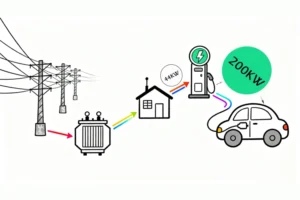


As electric vehicles (EVs) become more powerful and battery capacities continue to increase, the demand for high-performance charging solutions has accelerated across the globe. In commercial, municipal, and fleet applications, 480 volt 3-phase EV chargers are fast becoming the backbone of scalable and efficient EV charging infrastructure.
This article explores how these chargers work, why they’re essential for modern EV charging stations, and how regions like Europe, South America, Asia, and the Middle East are implementing this high-power solution in real-world deployments.

What is a 480 Volt 3-Phase EV Charger?
A 480V 3 phase EV charger operates on a three-phase electrical system, which is common in commercial and industrial settings. Unlike residential single-phase systems, three-phase power allows for:
Higher voltage delivery (typically 480 volts in North America, or 400V in Europe)(200v-1000v)
Greater current stability(max 250A)
Higher power throughput(support 60kw,80kw,120kw,160kw,180kw,240kw,360kw,480kw,720kw,1000kw and more power direct current charging stations)
Faster EV charging speeds, especially for Level 3 (DC fast charging) units
These systems are the technical foundation for Зарядные устройства для электромобилей 3-го уровня, making them ideal for public charging stations, highway corridors, commercial fleet hubs, and logistics parks.
Key Applications of 480V 3-Phase EV Chargers
1. Public Fast Charging Networks
In countries like Германия, Франция, Южная Корея, и UAE, governments and private operators are deploying 480V 3-phase EV chargers to support growing EV traffic. High-speed roadside stations use this setup to deliver charging speeds of up to 360 kW or 480KW and higher.
2. Fleet Charging
Delivery, taxi, and truck fleets in Brazil, Индия, и Казахстан increasingly rely on 3-phase chargers to minimize vehicle downtime and optimize operational logistics.
3. Commercial Real Estate
Shopping malls, business parks, and hotels in markets such as Малайзия, Turkey, и Mexico integrate 3-phase EV charging stations to offer value-added services to EV-driving visitors.

Power and Speed: What to Expect
The advantage of 480V 3-phase EV charging lies in its capability to handle high-power output. Depending on the charger design, these systems can support:
| Charging Power | Typical Output Voltage | Current (A) | Approx. Charging Time |
|---|---|---|---|
| 80 kW | 480V | ~104 A | 60–90 mins (80% charge) |
| 180 kW | 480V | ~312 A | 20–30 mins |
| 360 кВт | 480V | ~729 A | 10–20 mins |
These speeds are especially important for long-distance travel and high-usage vehicles, where Зарядные устройства уровня 2 would be insufficient.
Infrastructure Requirements
Installing a 480 volt 3-phase EV charger involves specific technical prerequisites:
Three-phase electrical service from the local utility
Heavy-duty cabling and switchgear
Dedicated transformers for energy regulation
Concrete pads or enclosures to house charging hardware
Load balancing systems to manage multiple units in one site
In emerging markets such as Colombia, Узбекистан, и Таиланд, utilities are beginning to modernize grid connections in high-traffic zones to accommodate 3-phase EV charging infrastructure.
Advantages Over Single-Phase Charging
| Характеристика | Single-Phase (240V) | 3-Phase (480V) |
|---|---|---|
| Max Power Output | ~22 kW | Up to 1000 kW |
| Suitable For | Homes, Light-use | Commercial, Fleet |
| Charging Time for 80% Battery | 4-8 часов | 20–45 minutes |
| Operational Cost Per Charge | Lower | Higher (but faster ROI) |
| Scalability | Limited | Excellent |
For applications that require Станция зарядки электромобилей уровня 3 performance, three-phase systems are the clear winner.
Global Deployment of 3-Phase EV Charging
Европа: Countries like Норвегия, Нидерланды, и Spain offer strong grid infrastructure for 3-phase Level 3 chargers, often installed in city centers and along highways,aslo docks and ports.
South America: In Argentina и Chile, smart cities are prioritizing 480 volt EV charger setups in green mobility projects, especially in urban bus and taxi fleets.
Asia: Китай и Япония lead the way with ultra-fast Зарядное устройство для электромобилей уровня 3 networks built entirely on three-phase grids, many of which support both CCS and CHAdeMO protocols.
Middle East: With growing EV adoption in Saudi Arabia и Oman, commercial installations are rapidly moving toward 480V Level 3 EV charger formats to handle rising energy loads and consumer expectations.

Choosing the Right 480V 3-Phase Charger
When evaluating the best 480 volt 3-phase EV charger for your business or project, consider the following:
Power rating (60kW–480kW) depending on expected traffic and vehicle types
Plug standards (CCS1,CCS2, CHAdeMO, GBT) for regional compatibility
Smart functionality: Remote monitoring, load balancing, RFID access etc.
Durability and safety: IP54+ protection, fireproof enclosure, temperature resistance
Maintenance and support: Access to certified service partners across your region
Manufacturers now offer modular units, allowing operators in countries like Вьетнам и Ukraine to scale their charger installations as usage increases.
Заключительные размышления
The global transition to electric mobility demands infrastructure that’s fast, scalable, and future-ready. 480 volt 3-phase EV chargers meet these needs, enabling fast charging in commercial, public, and fleet environments.
As governments and businesses push toward lower carbon emissions and higher energy efficiency, the importance of robust charging systems will only grow. Whether you are in Европа, South America, Asia, or the Middle East, investing in 3-phase EV charging stations is a step toward sustainable growth and innovation.