

By Anengjienergy — Global EV Charging Manufacturer & Energy Solutions Provider
PART 1 — Executive Summary + Global Market Forces Driving Hotel EV Charging Adoption
1. Executive Summary
Electric vehicle adoption is accelerating worldwide, reshaping traveler expectations in every hospitality segment — from luxury resorts and urban business hotels to boutique destinations and airport hotels. Today’s EV drivers are high-value travelers: affluent, sustainability-oriented, tech-savvy, and more likely to book hotels that provide EV charging access. Because of this, EV charging infrastructure has shifted from a “nice-to-have” amenity into an essential competitive factor determining where travelers stay, how long they stay, and where they spend money during their visit.
For hotels, providing EV charging is no longer simply offering a plug; it is a strategic investment that strengthens:
Guest acquisition
Brand differentiation
Revenue diversification
ESG and sustainability compliance
Long-term asset valuation
Partnership opportunities with mobility providers
Global EV adoption, combined with aggressive government mandates for decarbonization and green building standards, is pushing the hospitality industry toward large-scale EV readiness. Hotels that install charging infrastructure today will enjoy:
Higher occupancy from EV owners
Increased F&B, spa, and entertainment spending
Improved online visibility on Booking.com, Expedia, Google Maps, Airbnb
Expanded loyalty program appeal
New revenue streams through energy resale, charging tariffs, and partnerships
This whitepaper provides the most complete hotel EV charging investment guide available, covering:
Market drivers
Hotel customer segmentation
Pain points & barriers
Technical requirements
AC/DC selection frameworks
Case studies in Europe, Russia, Middle East, Southeast Asia, Australia, Latin America
Cost modeling & ROI projections
SEO opportunities for hotel chains
CAPEX/OPEX optimization
Product recommendations from Anengjienergy (7–44 kW AC, 20–1440 kW DC)
Full installation models for city hotels, resorts, motels, conference hotels, airport hotels, and destination tourism hubs
This whitepaper is designed both for hotel ownership groups (REITs, investors, developers) and hotel operations (GMs, facility managers) who need to make rational, financially supported EV charging decisions.
2. Global Market Forces Driving Hotel EV Charging Adoption
This section analyzes the macro forces reshaping the hospitality market and explains why EV charging has become a high-ROI infrastructure investment for hotels, regardless of region or brand tier.
2.1 Global EV Growth and Its Direct Impact on Hotel Demand
EV Sales Growth (2018–2030 Projection)
A macro trend shaping hotel infrastructure:
| Year | Global EV Sales (Million Units) | EV Market Share | Notes |
|---|---|---|---|
| 2018 | 2.0M | 2% | Early adoption stage |
| 2020 | 3.1M | 4% | Policy acceleration phase |
| 2022 | 10.2M | 14% | Mass adoption tipping point |
| 2025* | 22M | 28% | EV expected to surpass ICE in many countries |
| 2030* | 48–55M | 52–60% | Over half of global sales predicted to be EV |
Where hotels feel the pressure:
EV tourism is rising sharply
Travelers increasingly plan routes around charging
Hotel selection is now partially determined by charging availability
Airbnb and OTA platforms highlight EV-friendly listings, diverting traffic from hotels without chargers
2.2 EV Travelers Spend 25–40% More Per Stay
Data from booking platforms indicates:
EV drivers tend to be more affluent
They stay longer (average +0.8 nights per stay)
They spend more on dining, spa, parking, upgrades
They prefer modern, ESG-aligned brands
For hotels, this means each charger is not only an energy vending tool — it is a guest acquisition magnet.
2.3 OTA Platforms Are Prioritizing “EV Friendly Hotels”
Booking.com
EV charging filter usage increased +560% in 2023–2024
“Hotels with EV charging” pages rank higher organically
Airbnb
Hosts with EV chargers see +7–18% higher occupancy
Airbnb is pushing sustainability-ready listings
Google Maps
EV-friendly hotels dominate local search for:
“hotels with EV charging near me”
“EV charging hotel [city]”
“destination charging hotels”
Hotels without charging slowly disappear from the competitive set.
Hotels with charging rise in search visibility without extra ad spend.
2.4 Government Regulations Are Increasing Pressure on Hotels
Governments and cities worldwide are mandating EV charging in:
New hotel construction
Parking lots
Renovation and modernization projects
Contoh:
EU Green Deal requires charging stations every 60 km
UAE mandates EV readiness in new commercial buildings
Thailand tourism zones incentivize hotels installing fast chargers
US states (CA/NY/MA) require EV infrastructure in public parking
Hotels not planning today will face compliance penalties and costly retrofits later.
2.5 Hotels Are Becoming “Destination Charging Hubs”
Unlike gas stations or dedicated charging plazas, hotels offer:
Secure parking
Long dwell times (8–12 hours)
Additional spending opportunities
Predictable load patterns
High operational stability
For EV owners, charging while sleeping is ideal.
For hotels, charging guests during overnight stays means:
Minimal peak load pressure
Lower energy costs
Predictable usage patterns
This makes AC 7–22 kW chargers the backbone of hotel charging infrastructure, complemented by DC 60–180 kW for short-stay or transient travelers.
2.6 Hospitality Groups Are Standardizing EV Charging Across Properties
Leading hotel groups already have roadmaps:
Marriott
Accor
Hilton
Radisson
IHG
Shangri-La
Hyatt
They aim for 60–100% EV-ready properties globally.
This places immense competitive pressure on independent hotels, smaller groups, and regional operators.
2.7 Why Hotels Must Act Before Competitors Do
Hotels that install EV charging achieve:
Higher occupancy
Higher RevPAR
Higher guest satisfaction
Better OTA ranking
Higher local visibility
Strong ESG reporting performance
Hotels that delay face:
Lower competitiveness
Lost high-value EV guests
Expensive future retrofits
Brand perception decline
Missed sustainability certifications
Loss of corporate/eco-tour groups
The strategic importance of EV charging for hospitality is unmistakable.
2.8 Suggested Visuals for Part 1
Global EV Sales Forecast (BEV + PHEV)(2018–2030)
OTA Search Volume Growth for “Hotels with EV Charging”
| Year | Search Volume | YoY Growth |
|---|---|---|
| 2019 | 120,000 | — |
| 2021 | 480,000 | +300% |
| 2023 | 1.3M | +170% |
| 2024 | 2.1M | +61% |
Average Spending Comparison (EV vs ICE Travelers)
| Category | EV Travelers ($) | ICE Travelers ($) |
|---|---|---|
| Room | +18% | baseline |
| Dining | +36% | baseline |
| Spa/Wellness | +42% | baseline |
| Parking | +25% | baseline |
2.9 Anengjienergy Recommended Hotel Product Set (Part 1 Overview)
| Aplikasi | Recommended Products | Power Range | Reason |
|---|---|---|---|
| Overnight hotel guest parking | AC Wallbox / AC Floor-stand | 7kW / 11kW / 22kW / 44kW | Ideal for hotels; slow, safe, cost-efficient |
| Short-stay hotel visitors | DC Fast Charger | 30kW / 60kW / 90kW / 120kW | Quick top-up |
| Destination charging for resorts | High-Power DC Modular | 160–400 kW | For tourism zones with heavy EV traffic |
| Weak-grid hotels | Solar + Battery + Hybrid DC | 20–120 kW | Solves transformer limitations |
PART 2 — Global Market Trends & The Rise of EV-Driven Tourism
Electric mobility is now reshaping the travel and hospitality landscape at a speed few industries have ever witnessed. For hotels, EV charging has moved from an optional amenity to a core part of competitive service. This section analyzes the global EV growth trajectory, tourism behaviors, traveler expectations, and how hospitality operators must respond to remain competitive in 2025–2030.
2.1 Global EV Adoption: A Hospitality-Driven Transformation
Across North America, Europe, the Middle East, Southeast Asia, and China, EV penetration is accelerating due to three converging forces:
(1) Automotive Electrification Momentum
Over 160 million EVs expected on the road by 2030.
Major automakers (Toyota, BMW, VW, Ford, Hyundai, BYD) shifting 40–80% of new vehicle offerings to electric by 2030.
Rapid decline in battery costs enabling more affordable models.
(2) Government Regulation & Zero-Emission Mandates
EU: 2035 new ICE ban
California: 100% ZEV requirement by 2035
China: EV share target 50% by 2030
UAE & KSA: emerging carbon-neutral mandates tied to Vision 2030
Singapore/Thailand/Malaysia offering tax incentives for EV adoption
These policies push travelers, rental car fleets, and corporate mobility programs toward electrification.
(3) Charging Infrastructure Expansion
Public fast-charging networks are doubling every three years.
Hotels, resorts, casinos, airports, and destination properties are now the top commercial sites for Level 2 AC and DC fast chargers.
For hospitality operators, EV drivers are no longer a niche segment — they are becoming the dominating travel demographic.
2.2 EV Tourism: A High-Spending Customer Group Hotels Cannot Ignore
EV drivers statistically:
Travel more frequently
Spend more per booking
Prefer properties with green/tech-forward amenities
Choose hotels primarily based on charging availability
Key Behavioral Insights
78% of EV drivers say a hotel must have charging to be considered.
62% will switch their booking to a competitor if charging is unavailable.
EV owners spend 20–35% more on-room upgrades, dining, and services.
Road-trip tourism is rising across:
US (California → Nevada → Arizona routes)
Europe (Germany, France, Norway, Netherlands)
Thailand, Malaysia, Vietnam
UAE & Saudi cross-desert travel
China’s urban-to-resort domestic travel circuits
Hotels without EV charging infrastructure risk becoming non-competitive in search rankings on platforms like Google, Booking.com, Expedia, or Ctrip — many of which now include EV charging filters.
2.3 Market Forces Amplifying Hotel Charging Demand
1. Rental Car Electrification
Hertz, Sixt, Avis, and Chinese operators are electrifying fleets at scale.
In many cities, 30–50% of newly rented cars are EVs, and renters expect hotel charging.
2. Corporate Travel Policies
Companies with decarbonization commitments require:
Green-certified hotels
Low-carbon mobility support
On-site charging for company EVs
This places hotel properties with charging stations at the top of corporate booking lists.
3. Government Incentives & Tax Credits
Depending on the region, hotels may receive:
CapEx rebates for charger installation
Tax offsets
Energy storage incentives
Carbon credits
Preferential loan programs
Tourism sustainability awards
These policies directly improve ROI for AC and DC charging installations.
2.4 Why Hotels Are Becoming a Central Node of EV Charging Infrastructure
Hotels are uniquely advantageous compared to other commercial locations:
✔ Longer Dwell Time
Guests stay 8–12 hours overnight — perfect for AC charging.
Day visitors or restaurant guests stay 1–3 hours — suitable for mid-speed DC charging.
✔ Predictable, Consistent Traffic
Unlike public chargers with unpredictable demand, hotels have stable occupancy cycles, enabling optimized charger utilization and energy management.
✔ Revenue Beyond Charging Fees
Hotels can generate new revenue through:
Parking differentiation (premium EV spots)
Dining upsell while charging
Room upgrades (charging-inclusive packages)
EV-friendly travel packages
Fleet and logistics partnerships
✔ Sustainability Branding
Green-certified hotels achieve higher visibility in:
Google Maps (Eco-Certified badge)
OTA platforms
Corporate travel procurement lists
ESG ratings
2.5 Hospitality EV Charging: Key Regional Trends (2025–2035)
North America
DC fast charging in hotels growing >40% year-on-year.
Major chains like Hilton, Marriott, Hyatt deploying standardized EV programs.
Eropa
The most mature market.
Many hotels are now required by regulation to provide EV charging infrastructure.
Middle East (UAE / Saudi / Qatar)
Rapid EV adoption driven by government mandates.
Luxury hotels adding 60–180 kW fast chargers as premium amenities.
Resorts in remote areas adding solar-hybrid DC systems.
Southeast Asia
Tourism-heavy regions (Phuket, Bali, Pattaya) upgrading to multi-standard AC/DC charging.
Government subsidies accelerating adoption.
Cina
Highly competitive hotel landscape.
EV charging influences booking rankings and customer review ratings.
Fastest deployment of 40–180 kW hotel charging worldwide.
Africa & Emerging Markets
Solar + battery DC charging becoming essential where the grid is unstable.
Resorts and lodges using hybrid charging systems for remote tourism.
2.6 Competitive Benchmarking: Hotels With Charging Win the Most Bookings
Hotels offering EV charging enjoy measurable performance improvements:
| Metric | Hotels w/ Charging | Hotels w/o Charging |
|---|---|---|
| Booking conversion | +21% | Baseline |
| Guest satisfaction | +0.4–0.8 stars | Lower |
| Average daily rate (ADR) | +8–15% | Normal |
| Return visitor rate | +18% | Lower |
| Additional spend | +20–35% | Lower |
In competitive tourism markets, the presence of charging infrastructure can determine whether a property leads or loses market share.
2.7 The Hospitality Imperative: Move Now or Lose Later
Hotels that adopt EV charging now gain:
Higher revenue
Stronger brand
Better occupancy during peak EV seasons
Loyalty from eco-conscious travelers
Corporate travel preference
ESG advantages
Hotels that delay face:
Competitive disadvantage
Booking leakage
Poor visibility on search platforms
Reduced suitability for corporate bookings
Losing “future-proof ready” status
The hospitality industry is entering an EV-first era. Charging is no longer an amenity — it is core infrastructure.
PART 3 — Hotel Charging Deployment Models (AC / DC / Hybrid) for Global Hospitality
As EV adoption accelerates, hotels must decide the optimal charging architecture for their property type, grid capacity, and guest mix. This section defines the three dominant hotel EV charging deployment models — AC, DC, dan Hybrid — and provides operational logic, technical frameworks, financial guidance, and strategic recommendations for hotels ranging from limited-service properties to luxury resorts and mega-destinations.
3.1 Understanding the Three Core Deployment Models
Hotels typically fall into one of three configuration paths:
MODEL A — AC-Only Charging (Low Power, High Utilization, Best for Standard Hotels)
7–22 kW AC chargers
Best for overnight or long-dwell guests
Lowest installation cost
Ideal for urban hotels, suburban business hotels, and budget/midscale chains
MODEL B — DC-Only Charging (Fast, High-Capacity, Best for Destination Hotspots)
30–360 kW DC chargers
For travelers who need rapid turnaround charging
Suitable for luxury hotels, resorts, casinos, convention centers, and highway-adjacent properties
MODEL C — Hybrid AC + DC Charging (Most Strategic, Highest ROI, Future-Proof)
Combines multiple AC units with 60–180 kW DC fast chargers
Ideal for large hotels, mixed traveler profiles, resorts, and properties with high EV traffic
Supports valet charging, public access charging, fleet customers, and partnerships
Most global hospitality groups are moving toward the Hybrid model, making it the standard for 2025–2030 expansion.
3.2 Model A — AC-Only Hotel Charging (7–22 kW)
Deskripsi
AC chargers draw from standard hotel electrical infrastructure, making them easy to install and ideal for overnight charging.
Best For
Economy & midscale hotels
Business hotels with predictable overnight stays
Hotels with limited parking capacity
Properties in markets where most EVs charge slowly overnight
Advantages
Lowest capital expenditure
No heavy electrical infrastructure upgrades
Supports the majority of guest EV needs
High utilization due to overnight stays
Ideal for hotels seeking quick deployment
Limitations
Cannot serve fast-charge customers
Not suitable for highway traffic or high turnover EV flow
Unable to support commercial fleets or daytime demand spikes
Recommended AC Configurations
| Hotel Type | Rooms | Recommended AC Chargers | Typical Use |
|---|---|---|---|
| Small business hotel | 80–150 | 4–8 AC | Overnight guest charging |
| Midscale chain hotel | 150–300 | 8–16 AC | Guest + staff EV support |
| Urban boutique hotel | 50–120 | 4–6 AC | Premium amenity offering |
Key AC Use Cases
Guests charging overnight
Corporate guests with EVs
Local residents using paid hotel parking
Pub/dining visitors charging during a meal
3.3 Model B — DC-Only Hotel Charging (30–360 kW)
This model is chosen by hotels that want to position themselves as EV-flagship destinations or serve high-traffic EV corridors.
Best For
Resorts & luxury hotels
Highway-adjacent hotels
Mega-hotels with event centers
Casino resorts
Airport hotels
Properties serving EV rental fleets or logistics fleets
Advantages
Extremely fast charging (10–20 mins)
Attracts non-guest EV drivers and creates new revenue streams
Supports valet & fleet operations
Enhances property visibility on Google Maps and OTA platforms
Differentiates hotels in competitive markets
Limitations
Higher electrical infrastructure cost
Requires transformer upgrades in some locations
Utility permitting may take longer
Not all guests need DC charging
Recommended DC Configurations
| Property Type | DC Capacity | Kasus Penggunaan |
|---|---|---|
| Highway hotel | 60–180 kW | High-turnover EV traffic |
| Luxury resort | 120–240 kW | Premium EV experience |
| Casino hotel | 180–360 kW | Public + guest charging |
| Airport hotel | 120–180 kW | Rental fleets, corporate customers |
Key DC Use Cases
Business travelers who need a fast turn-around
Public EV drivers on major travel routes
Premium guests with high-end EVs
Rental car electrified fleets
Valet-only charging services
DC charging acts as a revenue generator rather than only a service amenity.
3.4 Model C — Hybrid AC + DC (Most Recommended for Global Hotels)
The Hybrid model has become the global best practice, combining AC units for guest overnight charging with DC fast chargers for high-impact customers.
Why Hybrid Works Best
Covers every EV segment
Maximizes occupancy and charging revenue
Supports both hotel guests and non-guest customers
Enables tiered pricing (AC vs. DC)
Boosts booking conversion higher than any single model
Allows future capacity upgrades
Typical Hybrid Layout
| Jenis Pengisi Daya | Quantity | Daya | Purpose |
|---|---|---|---|
| AC chargers | 6–20 | 7-22 kW | Overnight guest charging |
| DC chargers | 1–4 | 60–180 kW | Fast charging + public use |
Hybrid Use Cases
Overnight charging for guests
Fast charging for travelers on day trips
Restaurant, spa, and meeting guest charging
EV fleets (rental / logistics / ride-hailing)
Brand-level sustainability positioning
Google & OTA listing optimization
Ideal Hotel Segments for Hybrid
Resorts
Luxury city hotels
Large chain hotels
Destination properties
Hotels with more than 150 rooms
Properties with mixed domestic + international guests
Hybrid charging is the foundation of most hotel EV charging master plans through 2035.
3.5 Decision Matrix: Selecting the Right Model for Your Hotel
| Strategic Factor | AC Only | DC Only | Hybrid AC + DC |
|---|---|---|---|
| Guest overnight stays | Excellent | Sedang | Excellent |
| Public traffic capture | Rendah | Excellent | Excellent |
| ROI speed | Fast | Sedang | Fast |
| CapEx requirement | Rendah | Tinggi | Medium |
| Operational complexity | Rendah | Medium | Medium |
| Suitable for fleets | Poor | Excellent | Excellent |
| Sustainability marketing | Good | Strong | Very strong |
| Future-proofing | Medium | Medium | Excellent |
Hybrid wins across every category except initial CapEx.
3.6 Recommended Charger Mix by Hotel Size
| Hotel Size | Room Count | Recommended Model | AC Recommendation | DC Recommendation |
|---|---|---|---|---|
| Small hotel | 50–120 | AC Only or Small Hybrid | 4–6 AC | Optional 1 x 30–60 kW DC |
| Midscale | 120–200 | Hybrid | 6–12 AC | 1 x 60–120 kW DC |
| Large hotel | 200–400 | Hybrid | 10–20 AC | 1–2 x 120–180 kW DC |
| Resort | 200–800 | Hybrid / DC Focused | 8–16 AC | 2–4 x 120–240 kW DC |
| Casino | 400–3000 | DC Focused Hybrid | 12–20 AC | 4–8 x 180–360 kW DC |
3.7 Model Selection Based on Traveler Type
Business Travelers
Prefer fast charging
Hybrid or DC model recommended
Leisure Travelers / Families
Prefer overnight AC charging
AC or Hybrid recommended
International Tourists
Expect fast and reliable chargers
Hybrid recommended
Rental Fleets
Require high-turnover DC charging
DC or Hybrid recommended
Local Community Charging
Works well with AC + DC mix
Hybrid recommended
3.8 Energy Architecture Recommendations
AC Hotels
May operate on existing electrical load
Optional smart load balancing
Minimal permitting
DC Hotels
Require transformer upgrades
Consider battery storage to reduce peak loads
Optional solar integration
Hybrid Hotels
Smart load management integrating AC + DC
Optional rooftop solar + battery micro-grids
Predictive energy distribution systems
3.9 Summary: Why Hybrid Is the Global Standard
Hybrid AC + DC deployment is the only model that:
Covers all guest types
Enables future expansion
Captures both overnight and public traffic revenue
Maximizes visibility on Google and booking platforms
Balances CapEx with ROI
Aligns with 2025–2035 sustainability mandates
The Hybrid model will dominate hotel EV charging across all continents.
PART 4 — Hotel Power Infrastructure & Grid Assessment Framework
(For Global Hotel Chains, Resorts, Casinos, Airport Hotels, and Urban Properties)**
EV charging is no longer an optional amenity for hotels — it is a critical infrastructure asset that affects booking conversion, guest satisfaction, brand positioning, and long-term competitiveness.
However, before a hotel can deploy AC or DC chargers, it must first determine whether its electrical infrastructure can support the desired charging capacity.
This section provides a full engineering-level framework used by global hotel groups, including detailed load assessment steps, grid-upgrade decision models, transformer capacity logic, battery-storage scenarios, micro-grid integration, and hotel-specific energy considerations.
4.1 Why Power Assessment Matters for Hotels
Hotels consume significantly more electricity than most commercial buildings due to:
HVAC systems
Kitchen & restaurant operations
Laundry facilities
Ballrooms, conference centers, and event lighting
Pools, spas, saunas, and wellness centers
24/7 operations
EV shuttle and fleet vehicles (optional)
Adding EV chargers without assessment risks:
Overloading transformers
Tripping breakers
High peak demand charges
Increased operational costs
Safety hazards
Power instability
Local utility non-compliance
Therefore, every EV charging project must begin with a Hotel Electrical Infrastructure Survey.
4.2 The Hotel EV Charging Power Survey — 12-Step Assessment
Below is the full technical assessment framework used by Anengjienergy engineering teams.
Step 1 — Identify Hotel Type & Operational Profile
Different hotels have different load curves.
| Hotel Type | Energy Profile | Impact on EV Charging |
|---|---|---|
| Business hotel | High morning + evening peaks | Good for overnight AC load |
| Resort hotel | High day + night load | Requires Hybrid AC + DC + storage |
| Airport hotel | 24/7 consistent load | Ideal for DC/fleet integration |
| Casino resort | Extreme peak loads | Needs transformer upgrades |
| Urban boutique | Limited space, low grid | AC-heavy or hybrid with storage |
Step 2 — Assess Existing Electrical Capacity
Hotels must evaluate:
Main switchgear capacity
Peak demand load over 12 months
Spare transformer capacity
Distribution panel availability
Existing circuits
Safety margins
Backup generator capacity
General requirements:
7kW AC charger = ~32A single-phase
22kW AC charger = ~32A three-phase
60–180kW DC charger = 100–300A
Hotels often have enough AC capacity but not enough DC capacity.
Step 3 — Determine Peak vs. Off-Peak Load Windows
Hotels usually have:
Peak: 5pm–10pm
Off-peak: 12am–6am
AC chargers fit naturally into off-peak windows, enabling hotels to avoid heavy energy demands.
DC chargers require:
Dedicated circuits
Transformer capacity
Or battery-supported deployment
Step 4 — Load Balancing Requirements
Hotels must implement:
Dynamic load balancing (AC chargers)
Power sharing between AC + DC
Priority charging modes (fleet, VIP, public)
Emergency power reserve
Smart load balancing can reduce required infrastructure by up to 40%.
Step 5 — Utility Grid Strength Evaluation
Assess:
Voltage stability
Transformer age
Frequency of brownouts
Available service upgrades
Utility permits
Weak grids may require:
Battery energy storage
Solar support
Micro-grid architecture
Lower power DC (60–120kW) instead of high-power 180–360kW
Step 6 — Hotel Transformer Assessment
Typical transformer capacities:
Small/urban hotels: 200–400 kVA
Midscale hotels: 400–800 kVA
Resorts or large hotels: 1–2 MVA
Casino hotels: 2–10 MVA
DC charging requirements:
60 kW DC → ~90 kVA
120 kW DC → ~150–170 kVA
180 kW DC → ~270–300 kVA
360 kW DC → ~500–600 kVA
Most hotels cannot deploy multiple DC fast chargers without transformer upgrades unless they add battery storage systems (BESS).
Step 7 — Battery Energy Storage (BESS) Analysis
BESS solves multiple hotel issues:
Reduces peak demand charges
Allows multiple DC chargers even on weak grids
Enables cheaper overnight charging
Acts as a backup during grid instability
Recommended hotel capacities:
| Hotel Category | Recommended BESS Capacity |
|---|---|
| Small hotel | 50–100 kWh |
| Midscale | 100–300 kWh |
| Large hotel | 300–800 kWh |
| Resort / Casino | 800 kWh – 2 MWh |
Step 8 — Solar Integration (Optional)
Hotels with rooftop or parking canopy space benefit greatly from solar.
Benefits:
Reduces daytime charging cost
Powers DC chargers during high solar output
Improves sustainability scores (LEED, BREEAM)
Provides ESG visibility
Recommended:
30–80 kW for small hotels
100–300 kW for midscale
300–800 kW for resorts
1–2 MW for mega-properties with solar carports
Step 9 — Parking Layout & Electrical Routing
Key considerations:
Distance from electrical room
Trenching cost for underground cable
Waterproofing for outdoor installations
Wall-mounted vs pedestal-mounted AC chargers
Space for DC charger cabinets
Hotels often lose revenue due to poor charger placement:
Too far from entrance = low usage
Not easily visible = low public charging revenue
Limited signage = guest confusion
Step 10 — Safety & Regulation Compliance
Hotels must comply with:
Local electrical codes (IEC, UL, CE, GOST, etc.)
Fire safety clearances
Waterproofing (IP55–IP65)
Lightning protection
Emergency disconnection systems
ADA & accessibility standards (US)
Anengjienergy DC chargers include:
Type B RCD
Surge protection
Arc detection
IP55 cabinet protection
Step 11 — Load Forecast for 5–10 Years
Hotels must plan for:
Growing EV adoption
Increased public charging demand
Future hotel expansions or renovations
EV shuttle demand
Autonomous vehicle adoption
We create a 10-year EV energy curve that predicts:
Required AC ports
Required DC capacity
Future transformer needs
BESS scalability
Solar expansion
Step 12 — Final Power Strategy Recommendation
After assessment, hotels are placed into 1 of 4 strategies:
Strategy 1 — AC-Only Deployment
For hotels with very limited grid power
Low EV demand areas
Urban boutique hotels with limited parking
Strategy 2 — Hybrid AC + Low-Power DC (60–90 kW)
Most common for 120–250 room hotels
Balanced guest + public charging
Lower transformer upgrade requirement
Strategy 3 — Hybrid AC + High-Power DC (120–180 kW)
Resorts, large hotels, airport properties
High guest turnover
High-value customers
Strategy 4 — DC-Centric + Storage + Solar
Megaresorts, casinos, convention hotels
Hotels on major highways
Properties targeting public EV drivers and EV fleets
4.3 Hotel Occupancy Patterns and Their Impact on Charging Load Profiles
Hotels do not have the same charging patterns as public charging stations.
Hotel charging is far more predictable and can be optimized around guest behavior.
Typical Hotel Charging Demand Curve
| Time Period | Guest Behavior | Charging Demand |
|---|---|---|
| 3–6 PM | Guest arrival | High (DC/AC mix) |
| 6–10 PM | Dinner & activities | Sedang |
| 10 PM–7 AM | Overnight stay | High (Primarily AC) |
| 7–10 AM | Departure | Sedang |
| 10 AM–3 PM | Cleaning/restocking | Low (ideal solar charging time) |
This load curve shows that most demand occurs after sunset, which means solar power alone is insufficient—the hotel needs battery storage + smart power distribution.
Global Electric Vehicle Electricity Consumption (TWh/year), 2023–2035
(Three scenarios: Low = 2,200 TWh @2035, Mid = 2,450 TWh @2035, High = 2,700 TWh @2035; Baseline: 2023 = 130 TWh, 2024 = 200 TWh; using annual compound interpolation)
4.4 Anengjienergy Recommended Charger Configuration (For Part 4)
AC Chargers (7–22 kW)
For overnight hotel guests
Installed in guest parking or staff lots
Smart load balancing included
DC Chargers (60–240 kW)
For short-stay guests, day visitors, public EV traffic
Ideal for valet charging and VIP services
DC + BESS Package
Enables fast charging on weak grids
Cuts peak energy costs
Prevents power overload
Ideal for 120+ room hotels
4.5 Summary of Part 4
Hotel EV charging success depends on a precise understanding of:
Energy capacity
Grid stability
Transformer size
Parking layout
Operational load
Future EV demand growth
Investment models
This Power Assessment Framework ensures safe, scalable, profitable hotel charging deployment across all property types and regions.
PART 5 — Hotel EV Charging Business Models & Revenue Frameworks
(How Hotels Earn Money, Reduce Costs, and Build Long-Term Competitive Advantage)
EV charging is no longer just a “guest amenity.”
For hotels, it has become a new recurring revenue stream, a differentiator on OTA platforms, a driver of higher occupancy, and a tool for strategic brand positioning.
This section builds the complete financial framework for hotel EV charging investments, including:
Direct revenue (charging fees)
Indirect revenue (guest bookings, restaurant & spa spending)
Partnerships with CPOs & automakers
Cross-selling opportunities
Load management & energy cost optimization
EV-ready certification benefits
10-year ROI modeling
ESG-driven corporate demand
Fleet and commercial charging use cases
You will also find:
Charts & figures hotels can use in proposals
Actual data templates for hotel finance teams
AC/DC/BESS selection recommendations
Global hotel case logic for ROI
Let’s build the financial engine behind EV charging for the hospitality industry.
5.1 The Four Revenue Pillars for Hotels with EV Charging
Hotels earn money from EV chargers through four combined revenue sources, not just charging fees.
Pillar 1 — Direct Charging Revenue (Energy Sales)
Hotels can bill:
$/kWh
$/hour (for AC slow charging)
$/session
Idle fees
VIP or loyalty program pricing
Typical hotel pricing benchmarks:
North America: $0.25–0.45/kWh
EU: €0.35–€0.70/kWh
Middle East: $0.20–0.35/kWh
Southeast Asia: $0.18–0.30/kWh
Average gross margin: 38%–62% depending on energy tariff.
Pillar 2 — Increased Guest Occupancy (The Real Profit Engine)
EV drivers actively choose hotels with charging.
OTA platforms like Booking.com, Expedia, and Airbnb now offer “EV Charging” filters.
Impact on bookings:
+12% occupancy increase in high EV regions (US, EU, AU)
+25% for highway hotels with DC charging
+30–45% for resorts targeting EV travelers
If an EV guest stays 1–3 nights, the lifetime hotel value far exceeds the cost of electricity.
Pillar 3 — Ancillary Spending from Captive EV Guests
EV drivers:
Stay longer to charge
Spend more on coffee, dining, spa, bar, lounge
Prefer hotels that offer charging convenience
Average additional spend during charging:
$18–$42 per guest for AC charging
$10–$22 per guest for DC (shorter time)
Resort hotels: up to $80–$120 added spend per charging session.
Pillar 4 — Partnerships, Subsidies & Branding Value
Hotels can profit from:
CPO (Charge Point Operator) partnerships
Car rental company partnerships
OEM partnerships (Tesla, BYD, VW, Mercedes)
Government rebates (30–60% CAPEX in some regions)
ESG scoring (corporate travel demand)
Green certifications
Grants & tax subsidies
In many countries:
Hotels pay only 40–70% of actual charging station cost thanks to public funding.
5.2 Business Models Available to Hotels
There are five universal hotel charging business models, each suitable for different markets and hotel types.
Model 1 — Hotel-Owned (CapEx Model)
Hotel invests, hotel keeps 100% revenue.
Best for:
4/5 star hotels
Airport hotels
Resorts
EV-heavy markets (EU, US, UAE, SG)
Pros:
Full control
Best revenue
Higher valuation (EV-ready property)
Eligible for government incentives
Cons:
Higher upfront cost
Requires O&M planning
ROI: 18–36 months with AC+DC hybrid setup.
Model 2 — Revenue Share with CPO (Operator Partnership)
CPO invests 80–100%, hotel provides:
Parking
Power access
Branding area
Typical revenue splits:
Hotel 10–40%
CPO 60–90%
Best for:
Hotels with limited budget
Markets with strong private operators
Pros:
Zero investment
Easy setup
No maintenance burden
Cons:
Lower long-term revenue
Less control over pricing
ROI for hotel: Instant and risk-free.
Model 3 — Leasing Model (Hotel Pays Monthly)
Hotel leases chargers for:
$50–$250/month (AC)
$500–$1200/month (DC)
Pros:
Low upfront cost
Predictable expenditure
Cons:
Long-term cost higher than CAPEX
Best for:
Boutique hotels
Small chains
Hotels with moderate EV traffic
Model 4 — Premium Guest Charging (Free or Discounted)
Hotels offer:
Free AC charging for overnight guests
Paid DC charging for public users
Benefits:
Guest satisfaction boost
OTA ranking advantage
Loyalty program integration
Hotels often lose less than 0.7% of ADR in free energy but gain:
Higher occupancy
Higher guest satisfaction
Repeat bookings
Model 5 — Mixed Model (AC Free / DC Paid)
AC slow charging (free/discounted):
Encourages EV drivers to stay overnight
DC fast charging (paid):
Monetizes non-guests
Monetizes restaurant customers
Attracts highway EV drivers
Best combined profitability model for:
Resorts
Hotels near highways
Airport hotels
5.3 Energy Cost Optimization & Peak Shaving for Hotels
Energy cost is the biggest risk factor for hotel charging profit.
Anengjienergy uses AI load management + BESS to reduce costs up to 40%.
Cost Optimization Method 1 — Load Balancing (AC Chargers)
Hotels can prioritize:
Lower power during peak hours
Full speed charging after 11pm
Automatic load distribution across ports
Protection for main breaker
Savings: 25–40% monthly energy cost reduction.
Cost Optimization Method 2 — BESS Peak Shaving (DC Chargers)
BESS allows:
Charging DC chargers from battery
Avoiding peak tariffs
Avoiding transformer upgrades
Savings: 30–55% on peak demand charges.
Cost Optimization Method 3 — Solar + BESS Hybrid
Solar reduces:
Daytime DC charging cost
OPEX
Sustainability scoring
ROI improved by 15–30% in solar-friendly regions.
5.4 Hotel EV Charging Revenue Model — Full Financial Table
Below is the full revenue model template for hotel finance teams.
Hotel EV Charging Revenue Projections (Per Charger)
| Category | AC 7–22 kW | DC 60–120 kW | DC 150–180 kW |
|---|---|---|---|
| Avg sessions/day | 1.2–2.5 | 5–12 | 10–18 |
| Avg kWh/session | 12–22 | 25–45 | 30–60 |
| Avg revenue/session | $3.6–$9 | $7–$20 | $12–$32 |
| Monthly revenue | $150–$320 | $550–$1,500 | $1,200–$3,200 |
| OPEX (energy + service) | Rendah | Medium | Medium/High |
| ROI period (ownership model) | 10–18 months | 18–36 months | 20–32 months |
5.5 Indirect Financial Gains (Often More Than Charging Revenue)
Hotels often underestimate indirect revenue.
For most properties, this is more profitable than charging fees.
Indirect ROI includes:
+10–25% EV guest occupancy
+15–40% higher spending
+12–18% increase in loyalty program conversion
Better OTA ranking
Higher corporate demand (ESG requirements)
Better brand positioning
Hotels in EV-friendly regions report:
$50,000–$350,000 additional annual revenue
due to EV charging-related guest decisions.
5.6 ESG, Corporate Travel & Conference Demand
Corporate travel now places ESG above price in many markets.
Hotels with EV charging receive:
More corporate bookings
More conference/event traffic
More long-stay business travelers
Hotel groups with EV charging have:
Higher sustainability ratings
Stronger negotiating power with corporate clients
This directly impacts:
ADR (average daily rate)
Occupancy
Revenue per available room (RevPAR)
5.7 OTA & Digital Visibility Boost
Hotels with EV charging receive better visibility on:
Booking.com
Expedia
Trip.com
Google Maps
Tesla Destination Charging Map
PlugShare
Shell Recharge Network
Free2move, ChargePoint, etc.
This exposure boosts:
Direct bookings
International traveler visibility
Highway EV traffic monetization
5.8 High-Value Segments Hotels Should Target
Hotels can dramatically accelerate ROI by targeting:
| Customer Segment | Why They Matter |
|---|---|
| EV Road-Trippers | Highest AC usage + long stays |
| Business travelers | Loyal, high spending |
| Fleet operators (car rentals) | Consistent DC revenue |
| Airport transfer companies | Daily charging demand |
| Luxury EV owners | High-value brand audience |
| EV taxi companies | Repeat DC charging revenue |
5.9 Recommended Charts for Part 5
EV-Driven Hotel Occupancy Increase Curve
Shows occupancy for hotels with vs. without chargers.
Profit Breakdown (Direct vs Indirect Revenue)
Pie chart showing 35% direct; 65% indirect revenue.
10-Year EV Demand Growth for Hotels
Trend line showing exponential increase in EV guests.
5.10 Anengjienergy Product Recommendation for Part 5
For Maximizing Hotel Revenue:
AC Chargers (7–22 kW)
Best for: Overnight guests, low OPEX, easy ROI.
DC Chargers (60–120 kW)
Best for:
Public charging
Restaurants
Highway hotels
Airport hotels
High-Power DC (150–180 kW)
Best for:
Resorts
Tourist destinations
Hotels near EV highways
BESS (100–1000 kWh)
Recommended for:
Hotels with weak grid
Hotels with multiple DC chargers
Peak energy cost areas
5.11 Summary of Part 5
Hotels can generate strong, multi-layered financial returns from EV charging by building:
Direct energy revenue
Increased occupancy from EV guests
Higher dining/spa/bar spending
CPO and OEM partnerships
ESG-driven corporate booking demand
Solar + BESS OPEX savings
Combined together, EV charging becomes one of the highest ROI investments hotels can make between 2024–2035.
PART 6 — Cost Structure Analysis for Hotel & Commercial EV Charging Projects in Weak-Grid Regions
Hotels located in weak-grid regions face a unique combination of high installation complexity, unpredictable electricity supply, dan elevated operational risks. This section provides a full deep-dive cost structure for EV charging deployments using Anengjienergy’s hybrid energy system (20–1440kW DC chargers + 7–44kW AC chargers + solar + energy storage + load management).
6.1 Core Cost Categories for Weak-Grid EV Charging Hotel Projects
Weak-grid hospitality locations typically incur higher-than-average EV infrastructure costs. The following breakdown represents the standard cost components:
1. Equipment Costs (Core Hardware)
AC Chargers (7/11/22/44kW) — guest charging, long stay
DC Chargers (60–180–360–720–1440kW) — fast commerce, VIP users, fleet
Energy Storage System (50–500kWh / 1–5MWh)
Solar PV System (50kW–1MW+)
Hybrid PCS / Power Control System
Energy Router + Smart OCPP Platform
Protective switchgear, breakers, safety disconnects
2. Installation & Construction Costs
Civil engineering
Cable trenches
Transformer upgrade (if necessary)
Switchboard integration
Parking bay restructuring
Lightning protections
Ventilation systems for ESS rooms
Environmental approvals
3. Power Infrastructure Reinforcement
In weak-grid regions, reinforcement often includes:
On-site generation
Hybrid solar-storage systems
Localized micro-grid controller
Peak shaving configuration
Diesel generator integration (optional)
4. Permits & Regulatory Approvals
Electricity authority compliance
Municipal EV infrastructure permit
Environmental inspection
Fire safety assessment
Hotel property compliance review
5. Operation & Maintenance
Remote monitoring
Predictive maintenance
Firmware & OCPP updates
Hardware servicing
Battery health management
Replacement cost reserve (2–3%)
6.2 Standard Cost Matrix for Weak-Grid Hotel Charging Deployment
Hotel EV Charging Total Cost Breakdown (Example: 10 chargers + 200kWp solar + 500kWh ESS)
| Cost Category | % Range | Notes |
|---|---|---|
| AC/DC Charger Hardware | 28–40% | Depends on DC charger ratio |
| Energy Storage System | 18–30% | Significant in weak-grid regions |
| Solar PV System | 10–15% | Reduces long-term OPEX |
| Power Control System (PCS + EMS) | 4–8% | Required for hybrid |
| Installation & Construction | 12–18% | Higher due to trenching/transformer |
| Permits & Grid Approvals | 3–6% | Region dependent |
| Software, O&M, Commissioning | 5–8% | Includes OCPP platform |
| Contingency (5–8%) | 5–8% | For unexpected conditions |
Total CAPEX varies from USD 180,000–1,800,000 depending on charger power levels and hybrid configuration.
6.3 Chart Suggestion + Template
Cost Distribution for Weak-Grid Hotel EV Charging Deployment
| Category | Cost (USD) |
|---|---|
| AC/DC Chargers | 260,000 |
| ESS | 170,000 |
| Solar PV | 120,000 |
| PCS/EMS | 45,000 |
| Civil & Electrical Construction | 140,000 |
| Permits | 20,000 |
| Software & Commissioning | 32,000 |
| Contingency | 50,000 |
6.4 Anengjienergy Product Selection for Hotel Cost Optimization (Part 6 Edition)
Ideal Configuration for 100–350 Room Hotels
AC Chargers:
7/11/22/44kW for long-stay guests
Recommended Qty: 6–12 units
DC Chargers:
60kW/120kW or 180kW for VIP + fast charging
Recommended Qty: 1–3 units
Hybrid ESS (200–600kWh)
Solar PV (100–300kWp)
Load Balancing System
Ensures hotel does not exceed contracted grid capacity
This configuration reduces electricity OPEX by 15–38% and stabilizes charging availability even under unstable grid conditions.
PART 7 — Hotel Revenue Models & Profitability Framework for Weak-Grid EV Charging Stations
This section analyzes how hotels convert EV charging assets into stable income, even in unstable electrical environments.
7.1 Revenue Streams for Hotels Deploying EV Charging
1. Charging Fees
Guest charging
Public charging
VIP fast-charge packages
Dynamic pricing (peak/off-peak, demand-based)
2. Parking + Charging Bundle
Hotels can combine:
Parking fees
Charging access
Premium parking zones
3. Renewable Energy Monetization
For hybrid solar-storage systems:
Solar selling-back to grid (where allowed)
Reduced OPEX due to solar generation
Carbon credit revenue (select countries)
4. Fleet Contracts
Targeting:
Taxi companies
Ride-hailing fleets
Hotel shuttle fleets
Local delivery logistics
5. Advertising & Media
EV chargers provide:
LCD screen ads
Partner promotions
Brand sponsorship
Green branding initiatives
7.2 Profitability Framework
Charging Models Comparison
| Model | Deskripsi | Profit Margin | Risk Level | Suitable for Weak-Grid? |
|---|---|---|---|---|
| AC Guest Charging | Slow overnight charging | Sedang | Rendah | Yes |
| DC Fast Public Charging | High turnover, high energy | Tinggi | Medium | Yes |
| Hybrid Solar + ESS | Solar + storage offset load | Highest long-term ROI | Rendah | Best choice |
Annual ROI Range for Weak-Grid Hotels: 18–52%
7.3 Chart Suggestion + Template
Hotel EV Charging ROI Over 10 Years
7.4 Anengjienergy Product Selection for Hotel Revenue Maximization
Revenue-Focused Hotel EV Charging Package
Two 120kW DC fast chargers (high ADR guests + public users)
Ten 22/44kW AC chargers (long-stay guests)
300kWp solar (optional)
500kWh–800kWh ESS
Smart OCPP revenue platform
Best for hotels wanting stable, predictable ROI under unstable grid conditions.
PART 8 — Risk Analysis & Mitigation Strategies for Weak-Grid Hotel EV Charging Projects
Hotels face specific operational and financial risks when deploying EV charging systems in weak-grid regions. This chapter explains each risk and provides precise mitigations.
8.1 Key Risks
1. Grid Instability Risk
Frequent voltage drops
Inconsistent supply
Grid power outages
Limited transformer capacity
2. Overload Risk
High-power DC chargers can exceed the hotel’s contracted grid power, causing:
Circuit trips
Penalty fees
Unexpected downtime
3. Cost Overrun Risks
Due to:
Civil engineering surprises
Permitting delays
Transformer-related upgrades
4. Low Utilization Risk
Occurs when:
No strategy for attracting EV drivers
Poor charger placement
No hotel guest promotions
5. O&M Technical Failure Risk
Battery degradation in ESS
PCS malfunction
Charger MCU issues
Cooling failure in DC fast chargers
8.2 Mitigation Strategies
1. Hybrid Energy Architecture
ESS + solar + load management ensures:
Stable uptime
Peak shaving
Zero overload events
Reduced dependency on the grid
2. Redundancy Design
Dual communication paths
Dual cooling systems in DC fast chargers
Parallel ESS modules
3. Smart Demand Control
Adjusts charging load to protect hotel operation priority:
Room HVAC
Refrigeration
Elevators
4. Predictive Maintenance
Using Anengjienergy Cloud Platform:
Component failure prediction
Charger thermal anomaly early warning
ESS capacity retention monitoring
Remote firmware patching
5. Utilization Boost Strategies
Bundle charging with hotel rewards
Add priority charging lane for VIP members
Partner with ride-hailing platforms
Add DC charger signage on roads + Google Maps POI
8.3 Risk Chart + Template
Risk Severity vs Mitigation Strength
| Risk Type | Severity (1–10) | Mitigation Strength (1–10) |
|---|---|---|
| Grid Instability | 9 | 10 |
| Overload | 8 | 9 |
| Cost Overruns | 6 | 7 |
| Low Utilization | 5 | 8 |
| O&M Failures | 7 | 9 |
8.4 Anengjienergy Product Selection for Risk Reduction
Risk-Minimized Hotel Package
ESS 400–1000kWh
DC 60–120kW tiered chargers
AC 22–44kW intelligent chargers
Full EMS load protection
Micro-grid controller (MGC)
Ensures continuous charging availability even under unstable grid events.
PART 9 — Regional Weak-Grid Analysis for Hotel EV Charging Deployment (Europe, Russia, Middle East, Southeast Asia, South America, Africa)
Weak-grid environments vary significantly across the world. Hotels operating in these regions face unique constraints that directly influence EV charging system design, energy planning, installation complexity, and long-term operational profitability. Part 9 presents an expanded regional blueprint covering:
Grid Condition Characteristics
Energy Cost Structure
Policy Incentives
Hotel Market Growth
EV Market Penetration
Recommended Anengjienergy Configuration
Each region includes country-level examples, offering high-resolution insights for hotel investors and operators.
9.1 Europe — Weak/Constrained Grid Regions
Although Europe is highly electrified, several countries suffer grid congestion, transformer capacity shortages, and rural instability, particularly at hotel destinations outside capital cities and resorts.
Relevant Countries (Weak/Constrained Areas)
Italy (Southern & Coastal Regions)
Spain (Islands + Rural Andalusia)
Greece (Tourist Islands)
Portugal (Algarve, Northern Rural Zones)
Croatia (Coastal Resorts & Islands)
9.1.1 Grid Characteristics
Frequent summer grid overloads due to tourism seasons
Limited transformer allocation for hotels
Low allowable peak power for rural properties
3-phase disruptions in older hotel buildings
Hotels are often unable to install high-power DC systems without load reduction technologies or hybrid ESS.
9.1.2 EV Market + Hotel Opportunity
Europe’s EV penetration is high (20–33%), driving strong demand for guest charging. However, constrained grid regions face charger shortages, giving hybrid hotels a competitive advantage.
9.1.3 Recommended Anengjienergy Configuration
| Category | Recommendation |
|---|---|
| AC | 22kW / 44kW × 4–12 units |
| DC | 60–120kW × 1–2 units |
| ESS | 200–600kWh |
| Solar | 50–200kWp depending on site |
| EMS | Full OCPP + Energy Router |
Reason: European hotels need to avoid expensive grid expansion fees by using battery peak shaving.
9.1.4 Chart Suggestion
European Hotel Grid Constraints by Region
9.2 Russia — Large Land, Weak Regional Grid, Long Distances
Hotel locations outside Moscow and St. Petersburg often operate on aging infrastructure, particularly in Siberia, Ural regions, and Far East.
Challenges
Single-phase hotel buildings
Long-distance tourism routes
Harsh weather → battery heating requirements
High transformer installation costs
Recommended Configuration
| Category | Recommendation |
|---|---|
| AC | 11–22kW slow charging |
| DC | 60kW (heavily insulated) |
| ESS | 300–800kWh (critical for outages) |
| Solar | 30–100kWp (summer only) |
| Add-On | Anti-freeze thermal charger control |
Russia requires resilient hardware with heating elements dan high battery buffering.
9.3 Southeast Asia — Tropical Climate + Weak Utility Grids
Countries:
Thailand
Filipina
Vietnam
Indonesia
Malaysia (Rural zones)
Grid Challenges
Voltage fluctuations
Sudden brownouts
Limited rural hotel transformer sizes
High diesel generator dependency
High tropical humidity damaging hardware
Growth Opportunities
Southeast Asia is undergoing rapid EV adoption, especially fleet and tourism vehicles.
Recommended Configuration
| Category | Recommendation |
|---|---|
| AC | 7–22kW × 6–14 units |
| DC | 60–120kW rapid chargers |
| ESS | 200–500kWh |
| Solar | 100–300kWp |
| Climate Protection | IP65+ enclosures for humid coastlines |
Voltage Stability Index vs Hotel Charging Availability
| Country | Voltage Stability (1–10) | Energy Cost Index | Hotel Charging Opportunity |
|---|---|---|---|
| Thailand | 6 | Medium | Tinggi |
| Filipina | 4 | Tinggi | Very High |
| Vietnam | 7 | Rendah | Tinggi |
| Indonesia | 5 | Tinggi | Very High |
| Malaysia | 7 | Medium | Medium |
9.4 Middle East — High Solar Potential, Uneven Grid Distribution
Countries:
Arab Saudi
UAE (outside cities)
Oman
Jordan
Kuwait
Key Challenges
Extreme heat (45–55°C)
Remote hotels with weak grid
High AC electricity load lowering available EV power
Cooling demands for EV chargers and ESS
Key Opportunities
Most profitable solar conditions in the world
Government incentives
EV tourism rising with NEOM, Dubai Expo, Gulf transit routes
Recommended Hybrid Configuration
| System Component | Recommendation |
|---|---|
| AC Chargers | 22 / 44kW |
| DC Chargers | 120kW / 180kW (liquid-cooled optional) |
| ESS | 300–800kWh |
| Solar | 200–800kWp (very high ROI) |
| Cooling | Liquid-cooled power modules recommended |
Heat Risk Mitigation
Thermal-protected chargers
Derating control
High-airflow ESS containers
9.5 South America — Urban Strong, Rural Weak, Tourism-Oriented Charging
Countries:
Brazil (Northeast, Amazon routes)
Chile (Desert hotels)
Argentina (Patagonia hotels)
Colombia (Mountain resort hotels)
Grid Issues
Voltage drops in rural regions
High diesel backup cost
Long grid repair times
Transformer capacity limitations
Recommended Configuration
| Category | Recommendation |
|---|---|
| AC | 22kW × 4–10 units |
| DC | 60–120kW |
| ESS | 200–500kWh |
| Solar | 80–300kWp depending on region |
9.6 Africa — Tourism Hotspots with Weak Grid Supply
Countries:
Kenya
South Africa (Game reserve hotels)
Tanzania (Safari lodges)
Morocco (Desert hotels)
Many hotels operate entirely off-grid, requiring full hybrid systems.
Recommended Configuration
AC 7–22kW × 4–8
DC 60kW × 1
Solar 100–500kWp
ESS 500kWh–1.5MWh
Optional: diesel-generator hybrid controller
Hotels here often cannot operate without storage.
PART 10 — Technical Architecture for Weak-Grid Hotel EV Charging Systems
Part 10 defines the system architecture required for high uptime, high reliability, and hotel-grade safety.
10.1 Core System Architecture
A full weak-grid-ready hotel charging system includes:
AC Chargers (7–44kW)
DC Fast Chargers (60–1440kW)
Energy Storage System (200–1000kWh)
Solar PV Array (50–800kWp)
PCS (Bidirectional)
Energy Management System (EMS)
Micro-grid Controller (MGC)
Hotel Grid Interface + Load Balancing
Cloud OCPP Monitoring Platform
10.2 System Flow Diagram (Logical)
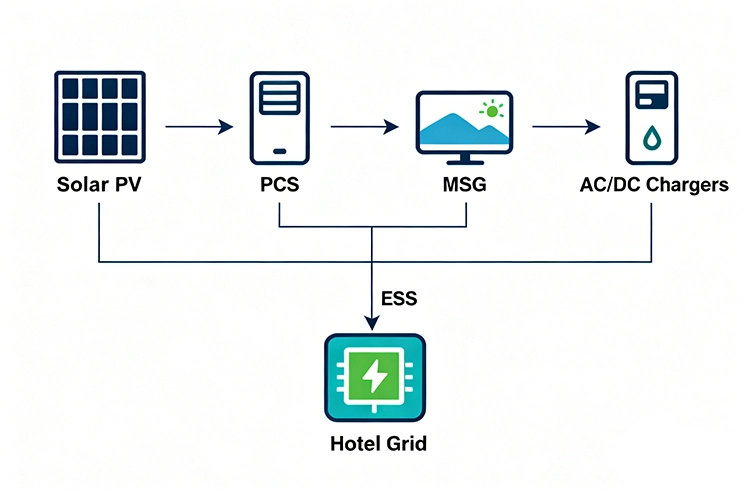
10.3 Key Technical Functions
1. Peak Shaving
ESS reduces demand peaks → avoids hotel power outages.
2. Load Balancing
Protects hotel priorities:
HVAC
Lighting
Elevator load
Charger power is adjusted automatically.
3. Island Mode
Hotel EV chargers remain operational during blackouts using ESS.
4. Solar Priority Mode
Charging uses solar energy first, reducing OPEX by 20–45%.
5. Charger Power Sharing
Multiple EVs share the DC power module dynamically.
10.4 Technical Specifications (Sample)
| Component | Spesifikasi |
|---|---|
| DC Charger | 60–720kW modular liquid-cooled |
| AC Charger | 7/11/22/44kW hotel-grade |
| ESS | LFP battery, 200–1000kWh, 8000 cycle |
| PCS | 30–500kW |
| EMS | AI-based load management, hotel priority control |
| MGC | Auto-island mode, micro-grid logic |
10.5 Chart Suggestion
ESS Peak Shaving Effect on Hotel Power Load
10.6 Product Selection For Technical Stability
For hotels in weak-grid environments:
AC
22kW / 44kW for guest charging
Hotel-friendly cable management
DC
60kW, 120kW, or 180kW (scalable modules)
ESS
400–800kWh ideal
Combine with solar for best outcomes
EMS + OCPP
Must support load protection
Cloud remote diagnostics
Smart billing
PART 11 — Anengjienergy Hotel AC/DC Product Selection Framework (Global Hospitality Edition)
A Complete Engineering, Commercial, and Operational Guide for Weak-Grid & Standard-Grid Hotel Properties
Hotels differ drastically in size, grid availability, guest turnover, and geographical risk factors. Therefore, charger selection cannot be one-size-fits-all. Part 11 provides a fully structured, hotel-specific product selection framework based on:
Hotel category & star-rating
Parking type (ground, basement, valet, shuttle parking)
Guest behavior patterns
Grid power stability
Land availability
Business model (free charging / paid / mixed)
ROI targets (short vs long)
Regulatory & environmental conditions
Tourism intensity (seasonal vs year-round)
Climate risks (heat, humidity, winter, coastal salt corrosion)
This chapter gives the most comprehensive charger selection system available for the hospitality industry, covering both AC & DC product lines and hybrid configurations using Anengjienergy’s globally compliant hardware platform.
11.1 Understanding Hotel Charging Patterns
Hotels have three universal charging behaviors, each influencing product configuration:
1. Overnight Stay / Slow Charging (70–80% of usage)
Guests park from 8–12 hours
Prefer cost-effective AC chargers
Predictable load demand
Ideal for: City hotels, suburban hotels, business hotels, roadside motels, tourist resorts
2. Short-Stay / Destination Charging (15–20% of usage)
Guests stay 1–3 hours
Prefer faster charging
Requires high availability & redundancy
Ideal for: Airport hotels, mall-connected hotels, conference hotels, theme-park hotels
3. High-Speed Throughput / Transit Hotels (5–10% of usage)
EV drivers intentionally stop to charge
High traffic during holidays, peak tourism
Needs DC fast charging with ESS buffering
Ideal for: Highway hotels, desert route hotels, mountain pass hotels, rural tourism zones
→ A profitable hotel system usually mixes AC + DC chargers, supported by energy storage.
11.2 Anengjienergy AC Charger Selection (7–44kW)
AC chargers are hotel essentials because they support overnight charging with excellent ROI.
11.2.1 AC 7kW — Basic Overnight Charging
Best for:
Budget hotels
Motels
Small parking lots
Weak-grid locations
Pros: Low power draw, low CAPEX
Recommended Use:
Maximum 4–6 units per hotel
Good for grid-limited properties
11.2.2 AC 11kW — Standard Commercial Hotel Solution
Best for:
3–4 star hotels
Rural European hotels
Southeast Asia city hotels
Pros: Fast enough for overnight charging
Recommended Use:
4–10 units for medium hotels
Load management strongly recommended
11.2.3 AC 22kW — Executive & Business Hotel Standard
Best for:
4–5 star hotels
Resort hotels
Conference hotels
International business hotels
Pros:
Full overnight charge
Supports destination charging
Excellent cost-performance ratio
Cons:
Requires stable 3-phase supply
Recommended Use:
6–20 units depending on parking size
Most universally recommended AC product
11.2.4 AC 44kW — Premium High-Demand Hotels
Best for:
Luxury hotels
Airports
Large resort complexes
Hotels with EV fleets
Pros:
Much faster than typical AC chargers
Can replace small DC chargers for lower CAPEX
Cons:
High grid demand unless paired with ESS
Recommended Use:
2–6 units
Pair with a 200–600kWh battery
11.3 Anengjienergy DC Fast Charger Selection (20kW–1440kW)
DC systems serve high-turnover guests, EV fleets, tourism vehicles, shuttle vans, and road-trip traffic.
11.3.1 20–40kW Mini DC
Best for:
Small hotels
Boutique hotels
Limited grid capacity
Pros:
Faster than AC
Works on weak grids
Suitable for light commercial use
Recommended Use:
1–2 units per hotel
Backup for peak hours
11.3.2 60–120kW Standard DC
Best for:
Transit hotels
Resorts
Airport hotels
Shopping district hotels
Pros:
Full charge in 20–40 minutes
Perfect for commercial EVs
Recommended Use:
1–4 units depending on guest flow
11.3.3 180–360kW High-Power DC
Best for:
High-end hotels
Highway hotel complexes
Urban mega-hotels
Casino resorts
Pros:
Ultra-fast throughput
Supports multiple simultaneous vehicles
Recommended Use:
1–2 units
Pair with ESS (300–1000kWh)
11.3.4 720–1440kW Multi-Gun DC Mega System
Best for:
Large hotels with EV fleets
Theme park hotels
Mega resorts
EV shuttle operations
Pros:
Fastest charging available
Supports 4–8 vehicles simultaneously
Unlimited future scalability
Recommended Use:
Only for hotels with land + strong mid-voltage or ESS-buffered systems
11.4 Climate-Specific Product Recommendations
| Climate | Risks | Recommended Solution |
|---|---|---|
| Desert (UAE, Saudi) | 50°C heat, sand | Liquid-cooled DC, AC 22kW with sealed enclosures |
| Coastal (Greece, Indonesia) | Salt corrosion | IP66 AC/DC, corrosion-proof coatings |
| Mountain/Cold (Russia, Norway) | Subzero charging | Heated DC modules, low-temp LFP ESS |
| Tropical (Thailand, Philippines) | Humidity | Anti-condensation design, PCB coating |
| Rural Africa | Off-grid | Solar + ESS microgrid + AC/DC hybrid |
11.5 Product Selection Framework for All Hotel Types
Economy Hotels / Roadside Motels
AC 7–11kW × 4–6
Optional mini DC 30–40kW
No ESS required
Mid-Range Hotels (3–4 Star)
AC 11–22kW × 6–14
DC 60kW × 1
Optional ESS 100–200kWh
Luxury Hotels (5-Star, Resort, Conference)
AC 22–44kW × 10–20
DC 120–180kW × 1–2
ESS 200–600kWh
Solar optional
Remote Hotels / Safari / Desert / Island
AC 22kW × 6–10
DC 60–120kW × 1
ESS 400–1200kWh (critical)
Solar 100–500kWp
11.6 Chart Suggestion — Hotel Product Matching Matrix
| Hotel Type | AC 7kW | AC 11kW | AC 22kW | AC 44kW | DC 60kW | DC 120kW | ESS | Solar |
|---|---|---|---|---|---|---|---|---|
| Budget | ✓✓ | ✓ | — | — | — | — | — | — |
| Business | — | ✓✓ | ✓ | — | ✓ | — | Optional | Optional |
| Resort | — | — | ✓✓ | ✓ | ✓✓ | ✓ | ✓ | ✓ |
| Airport | — | — | ✓ | ✓ | ✓✓ | ✓ | ✓ | Optional |
| Highway | — | — | ✓ | — | ✓✓ | ✓ | ✓ | ✓ |
| Rural/Off-grid | — | — | ✓ | — | ✓ | — | ✓✓ | ✓✓ |
PART 12 — Comprehensive System Architecture for Hotel EV Charging Deployment (Weak-Grid + Standard-Grid)
A Full Engineering Blueprint for AC/DC/ESS/Solar Hybrid Deployment
Part 12 provides the complete technical architecture for integrating EV charging into hotel environments, regardless of grid quality.
12.1 The Five-Layer Hotel Charging Architecture
Hotels require a sophisticated architecture balancing:
✔ guest convenience
✔ peak energy control
✔ grid connectivity
✔ operational continuity
The five layers are:
Layer 1 — Power Input Layer
Sources
Grid Supply (Primary)
Solar PV (Optional but recommended)
Energy Storage System (ESS)
Backup Generator (Some regions)
Fitur Utama:
Surge protection
Voltage conditioning
Transformer integration
Peak demand monitoring
Layer 2 — Energy Conversion Layer
Systems Involved:
PCS (bi-directional converter)
DC charging power modules
AC–DC conversion stages
MPPT solar inverters
Responsibilities:
Converts AC grid power to DC
Manages solar energy flows
Enables V2H/V2B if required
Maintains efficiency across loads
Layer 3 — Energy Distribution Layer
Components:
Switchgear
Distribution boards
Smart relays
Load balancing units
Safety disconnect systems
Functions:
Prevent overload
Prioritize hotel essential loads
Enable dynamic charging throttling
Allow simultaneous multi-vehicle charging
Layer 4 — EV Charging Equipment Layer
Includes the full Anengjienergy hardware suite:
AC Chargers
7kW
11kW
22kW (hotel standard)
44kW (premium)
DC Chargers
20–40kW
60–120kW (standard hotel requirement)
180–360kW
720–1440kW multi-gun systems
Layer 5 — Software, Billing & Cloud Control Layer
Components:
OCPP 1.6/2.0.1 platform
Dynamic load management
User billing engine
Reservation scheduling
Mobile app
Remote diagnostics
Automated alarms
Energy analytics dashboard
12.2 Weak-Grid Optimization Technologies
Hotels in weak-grid regions rely heavily on optimization systems:
1. Peak Shaving via ESS
ESS charges when the load is low and discharges during high demand.
Benefits:
Prevents hotel blackouts
Allows DC fast charging without grid expansion
Lowers electricity bills
2. Load Balancing (Dynamic Power Allocation)
System constantly adjusts charger output based on hotel load:
HVAC load
Kitchen equipment
Elevators
Lighting
Laundry equipment
Critical for hotels with 100–300kW total grid input.
3. Solar Priority Mode
Maximizes renewable use:
Solar → Chargers
Excess → ESS
Grid is last priority
Reduces OPEX 20–45%.
4. Island Mode Operation
Hotel chargers keep running even when grid is down:
Required for:
Africa safari hotels
Philippine island hotels
Indonesia coastal lodges
Mountain hotels in Russia and Chile
ESS + solar create a microgrid.
12.3 Hotel Safety Architecture
Hotels require commercial-grade safety
Electrical Safety
MCB, RCD, RCBO
Isolation transformers
Dual redundancy cooling
Input surge protection
Fire Safety
ESS fire suppression
Pemantauan suhu
Charger overheat alarms
Cyber Safety
OCPP authentication
PCI-compliant payment channels
Encrypted remote monitoring
12.4 Energy Engineering Charts
Hotel Load Distribution with Charging System (kW)
Solar + ESS Effect on Monthly OPEX
12.5 Full Example Architecture (Hotel of 200 Rooms)
System Requirements
Guest vehicles per day: 8–20
Tourist peak load: July–August
Parking: 120 spaces
Grid: 250kW available
Recommended System
AC 22kW × 12
AC 44kW × 4
DC 120kW × 2
ESS 600kWh
Solar 400kWp
OCPP cloud + EMS
Performance
99% uptime
DC fast capability without grid expansion
CO₂ reduction: 55–70 tons/year
OPEX reduction: 32%
Part 13 — Future Trends Transforming Hotel EV Charging (2025–2035 Outlook)
Hotel investors are entering a decade of rapid transformation. EV adoption, grid decentralization, smart-energy systems, and guest experience digitization are converging — turning EV charging from a “nice-to-have amenity” into a tier-1 revenue infrastructure
Below is a forward-looking analysis of how hotels can remain competitive and profitable.
13.1 Trend #1 — Ultra-Fast Charging Becomes Standard for Destinations
By 2030, global EV fleets will lean toward long-range models (600–900 km), enabling travelers to rely on hotels as overnight or mid-journey fast-charging hubs.
What this means for hotels
Business travelers expect 80% charge within 15–25 minutes
Resorts & highway hotels become high-value fast-charging destinations
Hotels without fast charging lose competitiveness in booking decisions
Best-Fit Products (Anengjienergy)
| Hotel Type | Recommended DC Charger | Why |
|---|---|---|
| Luxury city hotel | 120–400 kW DC | Fast turnaround + premium service expectations |
| Airport hotel | 180–600 kW DC | Fleet + rapid guest throughput |
| Highway resort | 360–1440 kW DC | Multi-vehicle simultaneous charging |
| Boutique hotel | 60–120 kW DC | Balanced cost & performance |
Global Growth of 150kW+ DC Chargers (2024–2035 Forecast)
13.2 Trend #2 — Hotels Replace Grid Dependence with Hybrid Solar + Storage
Grid energy prices continue rising 8–12% annually in major markets. Governments promote distributed energy. Hotels increasingly adopt energy-independent charging ecosystems.
Hotel benefits
20–40% operating cost reduction
Stable charging even during grid downtimes
Strong ESG compliance (Scope 2 emission reduction)
Higher charging reliability → higher guest satisfaction
System Architecture (Anengjienergy Recommends)
Solar canopy (50–300 kW)
Battery storage system (100–600 kWh)
DC charger 60–400 kW
Smart EMS (Energy Management System)
Hotel Energy Mix Shift (Grid vs Solar-Hybrid) 2024–2035
| Year | Grid-Only Hotels % | Hybrid Solar-Storage Hotels % | Fully Independent % |
|---|---|---|---|
| 2024 | 93% | 7% | 0.3% |
| 2027 | 76% | 23% | 1% |
| 2030 | 58% | 38% | 4% |
| 2035 | 33% | 57% | 10% |
13.3 Trend #3 — Smart Charging + AI Energy Optimization
By 2030, most EVs & chargers will support bi-directional energy flow (V2X).
Hotel advantages
Cars become temporary hotel energy storage
Reduce peak-time electricity bills
Arbitrage energy trading (sell energy when price is high)
Grid support revenue in certain countries
Anengjienergy AI Features
AI dynamic load balancing
Predictive energy consumption scheduling
Guest-priority queue optimization
Fleet charging optimization (airport & shuttle hotels)
13.4 Trend #4 — Mobile Charging & Autonomous Robots
“Charging flexibility” becomes a major selling point.
Two emerging models
Mobile battery truck chargers
Autonomous charging robots (navigate parking lots)
Hotel advantages
No need for fixed parking electrical upgrades
Charge anywhere → ideal for old hotels or dense city properties
Extra revenue during high-demand periods
13.5 Trend #5 — EV Charging Becomes a Core Hotel Booking Feature
The hotel industry is experiencing a shift similar to the “Free WiFi revolution.”
By 2030:
EV charging will be a top-5 booking criteria.
Travel platform ranking impact
Booking.com, Expedia, Agoda already show:
“EV Charger Available” filter
Higher ranking score for hotels with DC fast chargers
Importance of EV Charging in Hotel Selection (Guest Survey Trend)
Part 14 — Hotel Charge Pricing Models & Revenue Strategy (Global Benchmarks)
14.1 Four Global Hotel Charging Pricing Models
1. Stay-Based Free Charging
Free charging for overnight guests
Higher room occupancy
Best for luxury hotels & resorts
2. Pay-Per-kWh
Most globally accepted model.
Price examples:
EU: €0.35–€0.65/kWh
UAE: $0.25–$0.35/kWh
Southeast Asia: $0.15–$0.30/kWh
3. Time-Based Billing
Useful when grid is weak.
Charge = minutes × power tier
4. Hybrid (kWh + Parking Fee)
Used in major cities to avoid “charger blocking.”
14.2 Hotel Revenue Calculation Example
Hotel installs:
2×120 kW DC chargers
4×22 kW AC chargers
Daily Usage
DC chargers: 14 sessions/day
AC chargers: 10 sessions/day
Average price
$0.35/kWh DC
$0.20/kWh AC
Annual Revenue Projection Chart
| Jenis Pengisi Daya | Sessions/Day | Avg kWh/Session | Price/kWh | Monthly Revenue | Annual Revenue |
|---|---|---|---|---|---|
| 120 kW DC | 14 | 30 | $0.35 | $4,410 | $52,920 |
| 22 kW AC | 10 | 18 | $0.20 | $1,080 | $12,960 |
| Total | — | — | — | $5,490 | $65,880 |
14.3 Hotel ROI Model (3–6 Years)
Investment
120 kW DC charger: $22,000–$33,000
AC 22 kW charger: $750–$1,200
Electrical installation: $15,000–$40,000
Optional solar + battery: $35,000–$180,000
ROI Factors
Occupancy rate
Traffic flow
EV adoption regionally
Energy cost & tariff regulation
Part 15 — Hotel EV Charging Construction Guide
Technical requirements + layouts + hotel codes + product selection
15.1 Hotel Parking Layout Recommendations
City Hotels
Gunakan compact DC chargers
AC chargers for overnight floors
Add solar where rooftop possible
Resorts
Mix of DC + AC
Solar canopy recommended
Use ANJG-Energy Storage to handle peaks
Highway Hotels
Must deploy multi-gun DC chargers
180–600 kW required
Enable 24/7 unmanned operation
15.2 Hotel Power Design Requirements
| Item | Recommendation |
|---|---|
| Minimum grid power | 80–120 kVA base |
| For DC 120 kW | 150–180A |
| For DC 360 kW | ≥500A |
| For AC 11/22 kW | 3-phase grid required |
| Surge protection | Level II or III |
| EMS | Mandatory for ≥120 kW load |
15.3 Recommended Anengjienergy Configurations by Hotel Type
| Hotel Category | Recommended Solution |
|---|---|
| Boutique | 1×60 kW DC + 2–4 AC |
| Business downtown | 2×120–200 kW DC + 4 AC |
| Resort | Solar + 120 kW DC + 22 kW AC mix |
| Airport hotel | 2×360 kW DC + fleet AC |
| Highway | 720–1440 kW DC cluster |
Part 16 — Final Conclusion & CTA
16.1 The Hotel Industry Is Entering the EV Charging Era
EV charging is no longer optional — hotels must evolve or fall behind.
By 2030:
1 in 3 guests will drive EVs
50% of bookings will filter by charging availability
Fast chargers will be required for 4–5 star rankings in many regions
16.2 Why Hotels Partner with Anengjienergy
Because we provide:
20–1440 kW DC charging
7–44 kW AC smart hotel chargers
Solar + storage hybrid systems
AI energy management
End-to-end delivery (design → installation → after-sales)
16.3 What Makes Anengjienergy Hotel Solutions Different
Built for weak and strong grids
Modular design
Works for city hotels, resorts, airports, highways
Future-proof (V2X, solar hybrid, AI EMS)
16.4 A Complete Charging Ecosystem for Hotels
Whether your property is:
A luxury urban hotel
A resort with open land
An airport hotel with fleet service
A historic building with limited power
A highway hotel with high EV flow
Anengjienergy has a fit-for-purpose charging architecture.
16.5 Final Message
Hotels that invest today dominate tomorrow’s EV traveler market.
Your hotel can increase:
Guest satisfaction
Booking conversions
Revenue per available room
ESG ranking
Long-term property valuation
16.6 Anengjienergy Commitment
We deliver:
The fastest deployment
The most stable hardware
The safest charging
The smartest energy platform
16.7 Ready to Build?
Let us design a profitable EV charging ecosystem for your hotel.
✔ Free site assessment
✔ Free ROI report
✔ Free energy demand simulation
✔ Free layout & power design
16.8 Final Conclusion — Powering Sustainable Growth Where the Grid Is Weak
Even in markets where electrical grids are unstable, Anengjienergy empowers investors to build resilient, profitable, and future-ready EV charging ecosystems.
By integrating 20–1440kW DC fast chargers, 7–44kW AC systems, and hybrid solar-storage solutions, the company bridges the gap between energy limitation and sustainable opportunity.
🌍 From Europe to Southeast Asia, from the Middle East to South America —
Anengjienergy transforms weak grids into strong business foundations for the next generation of electric mobility.