

EV Charger with Credit Card Reader: Enhancing Public Charging Accessibility
As electric vehicle adoption continues to grow globally, accessibility and ease of payment are becoming just as important as charging speed. One of the most effective solutions for improving the user experience is the EV charger with credit card reader. This feature eliminates the need for special apps or membership accounts, making EV charging as simple as paying for fuel.
From Europe à South America, and from Southeast Asia à Central Asia, municipalities, businesses, and charging network operators are upgrading their infrastructure to include credit card-enabled chargers.

Why Credit Card Payment Matters for EV Charging
While mobile apps and RFID cards are common in EV charging, they can create barriers for first-time users, tourists, or drivers from different networks. By integrating a credit card reader into EV chargers, operators can:
Attract more users by offering familiar payment methods
Increase charging revenue with faster, easier transactions
Reduce customer support issues caused by app or account problems
Meet regulatory requirements in certain regions (e.g., EU mandates for open payment systems)
In markets like Germany, UK, Brazil, et EAU, public charging points with card readers are quickly becoming the standard.
Key Features of an EV Charger with Credit Card Reader
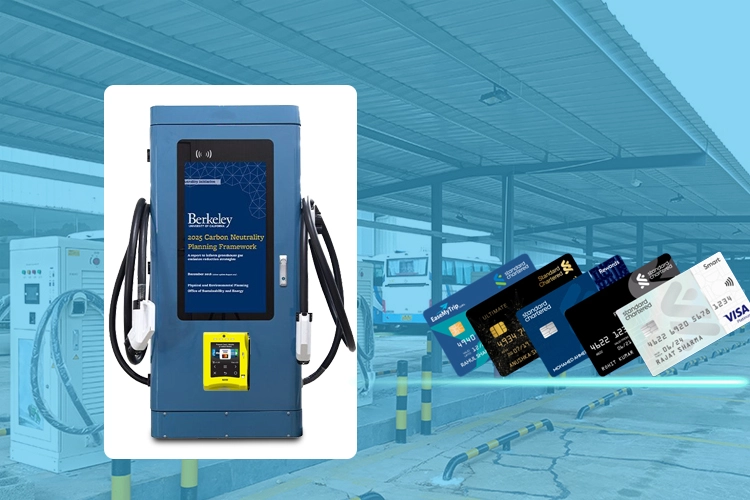
Universal Payment Acceptance
Supports Visa, Mastercard, AMEX, and contactless payments such as Apple Pay or Google Pay.Integrated Billing Software
Real-time transaction processing with receipts available via SMS or email.Secure Encryption
Compliance with PCI-DSS standards to protect user payment data.Multiple Charging Levels
Available for Level 2 AC chargers et Level 3 DC fast chargers, depending on site needs.24/7 Monitoring and Remote Access
Operators can track transactions, energy usage, and charger status remotely.
Where EV Chargers with Credit Card Readers Are Most Useful
Highway Service Areas – Allow quick payments for long-distance drivers in France, Spain, et Turkey
Tourist Destinations – Convenient for visitors in Thaïlande, Malaysia, et Mexico who may not have local charging accounts
Urban Commercial Zones – Ideal for shopping malls, offices, and hotels in Russia, Kazakhstan, et Colombia
Fleet Depots – Simplifies payment tracking for fleet managers operating in multiple cities
Installation Considerations
When installing an EV charging station with a credit card reader, operators should consider:
Type de chargeur – Decide between AC Level 2 or DC Level 3 units based on location and traffic volume
Internet Connectivity – Card readers require reliable network access via Ethernet, 4G/5G, or Wi-Fi
Maintenance Access – Readers should be easy to service and replace if damaged
Local Regulations – Some countries require specific payment methods or receipt options
Cost of Adding a Credit Card Reader
Integrating a credit card reader into an EV charger adds to the installation and operational costs. On average:
| Component | Estimated Additional Cost (USD) |
|---|---|
| Card Reader Hardware | $500 – $1,500 |
| Software Integration & Setup | $300 – $800 |
| Ongoing Transaction Fees | 1.5% – 3% per transaction |
| Maintenance & Service | $100 – $300 annually |
In the UK et Western Europe, costs may be higher due to stricter payment compliance regulations. In Latin America et Southeast Asia, costs may be lower but network reliability must be ensured.
Advantages for Operators and Users
For Operators:
Higher revenue potential from walk-in EV users
Improved station utilization rates
Competitive advantage in attracting both locals and tourists
For Users:
No need for sign-ups or apps
Fast and familiar payment process
Increased trust due to transparent pricing
Global Adoption Trends
Europe: Countries like Netherlands et Norvège are mandating open payment systems for new public chargers.
Moyen-Orient: EAU is equipping most new fast-charging points with credit card-enabled EV chargers to cater to international visitors.
Asia: Singapore et Japan are adding them in tourist-heavy locations to enhance convenience.
South America: Chile et Argentina are exploring this option in urban pilot programs.
Future Outlook
As EV adoption grows, EV chargers with credit card readers will likely become the industry standard, especially in public and semi-public charging networks. Integration with other payment methods—like QR codes, mobile wallets, and plug-and-charge technology—will further improve the driver experience.
For operators in Russia, Saudi Arabia, ou Indonesia, early adoption of card-enabled chargers can provide a competitive advantage while meeting the demands of a rapidly expanding EV user base.
Réflexions finales
An EV charger with a credit card reader bridges the gap between traditional fueling and modern EV charging. It delivers convenience, accessibility, and operational efficiency for both operators and drivers. Whether deployed in a busy European city, a South American tourist hub, or an Asian business district, this feature can significantly enhance the EV charging experience.