

As the world accelerates toward clean energy transformation, 2025 marks a defining year for the EV charging ecosystem. Across Europe, Asia, the Middle East, and emerging Central Asian markets, commercial EV charging networks are expanding at record speed, backed by both technological innovation and policy support.
This article explores two key perspectives:
1️⃣ The leading commercial EV charging brands across major global regions and their competitive advantages.
2️⃣ A spotlight on global EV charger manufacturers, highlighting AnengJienergy — an advanced energy and EV charging solutions provider offering customized, intelligent production and global service support.
I. Global EV Charging Network Overview
1. Europe: The Pioneer of High-Speed and Cross-Border Charging
Europe remains at the forefront of EV charging infrastructure with robust regulatory frameworks, unified standards, and strong inter-country cooperation.
IONITY (Germany) – A joint venture by BMW, Mercedes-Benz, Ford, and Hyundai, offering 350 kW ultra-fast charging across 24 European countries. Advantages: broad coverage, high power, interoperability.
Allego (Netherlands) – Operates over 40,000 charging points with flexible AC/DC solutions. Advantages: dense network, user-friendly payments, and open access.
Efacec (Portugal) – One of Europe’s oldest charger manufacturers, exporting to over 65 countries. Advantages: strong engineering reliability and global reach.
Schneider Electric (France) – Integrates EV charging with smart grids and energy storage. Advantages: advanced energy management and sustainability integration.
EVBox (Netherlands/Belgium) – Offers residential, commercial, and public charging platforms with intelligent cloud management. Advantages: comprehensive product range, excellent UX.
Europe’s fast, reliable, and standardized network continues to define global best practices in commercial EV charging.
2. Asia: Innovation and Government-Driven Growth
India
Tata Power – India’s largest charging network, expanding across airports, malls, and residential areas. Strength: government cooperation and nationwide coverage.
Kazam – Focused on two- and three-wheeler EV charging, addressing last-mile urban transport. Strength: cost-effective and scalable.
Japan
Japan aims to build over 300,000 public charging points by 2030.
ENEOS & TEPCO Networks – Leading operators in partnership with Nissan and Toyota. Strength: high reliability, CHAdeMO standard stability, and mature consumer adoption.
South Korea
Korea is rapidly deploying nationwide high-power DC fast chargers.
Chaevi – Provides end-to-end solutions from production to maintenance.
Hyundai E-Pit – Hyundai’s proprietary ultra-fast charging network.
Strength: government incentives, advanced automation, and high-tech integration.
Asia demonstrates a blend of technological innovation and local adaptability, positioning it as a key growth engine for the global EV ecosystem.
3. Central Asia: Emerging Market Momentum
Central Asia’s charging market is accelerating, driven by urban electrification and regional energy strategies.
Voltauto (Uzbekistan) – Offers customized commercial charging for government and private sectors. Strength: regional partnerships and supportive policy.
Adele Energy Group (Kazakhstan) – Manufactures AC/DC fast chargers locally. Strength: quick response, strong localization.
Chinese entrants such as Winline Tech and Grasen Power are entering Central Asia, providing affordable and standardized solutions that help shape the region’s EV infrastructure.
4. The Middle East: From Oil to Green Energy
Oil-producing nations are transitioning toward electric mobility with ambitious national programs.
EVIQ (Saudi Arabia) – A national project aiming to install 5,000 fast chargers by 2030. Strength: state backing, funding, and unified standards.
DEWA (Dubai) – Operates public charging across malls, airports, and residential zones, offering remote monitoring and smart billing.
ADNOC Distribution (UAE) – Plans over 1,000 fast chargers integrated with its fuel retail network. Strength: energy diversification and dual-mode service.
The Middle East’s strategic investments are setting the stage for large-scale EV adoption across the Gulf region.
5. Southeast Asia: Fast Growth and Regional Collaboration
Southeast Asia is one of the fastest-growing EV charging markets, driven by supportive policies and private investment.
Charge+ (Singapore/Malaysia) – A leading cross-border charging operator with intelligent roaming systems. Strength: connectivity and enterprise-grade services.
Gentari Go (Malaysia/Thailand/India) – Petronas’ green energy brand integrating renewable energy and EV charging.
Evolt (Thailand) – Collaborates with the Thai government to deploy nationwide fast-charging stations.
Philippines – Under the EVIDA Act, aims to install 7,300 charging stations by 2028. Operators like SM Supermalls y EVIDA projects are driving growth. Strength: strong policy support and massive untapped potential.
Southeast Asia stands out for its cross-border collaboration, rapid infrastructure rollout, and government-backed incentives.
II. Global EV Charger Manufacturers: Innovation and Capability
Manufacturers are the backbone of the EV ecosystem — defining safety, performance, and scalability.
ABB (Switzerland) – Covers all segments from residential to ultra-fast public chargers. Strength: global reach and high compatibility.
Heliox (Netherlands) – Specializes in bus and fleet fast-charging solutions. Strength: engineering precision and modularity.
Kempower (Finland) – Known for modular DC chargers with dynamic load management. Strength: flexibility and cost efficiency.
Winline Technology (China) – Supplies high-efficiency DC power modules with advanced cloud control systems.
ZEROVA (Taiwan) – Focused on customized EV charging hardware with integrated cloud monitoring.
AnengJienergy: The Global Force in Customized EV Charging Solutions
AnengJienergy stands out as an innovative and globally oriented EV charger manufacturer, offering a complete range of solutions from residential units to commercial and ultra-fast DC charging systems.
Customized Manufacturing: The company’s factory supports OEM and ODM production of diverse charging stations tailored to customer specifications.
Intelligent Service Systems: Each charger supports remote monitoring, online maintenance, fault diagnosis, and software updates.
Comprehensive Global Support: AnengJienergy provides on-site installation guidance, system commissioning, and technical training, ensuring smooth deployment worldwide.
Integrated Energy Management: The company’s systems support solar and storage integration (PV + Storage + Charging), helping clients achieve smart, sustainable operations.
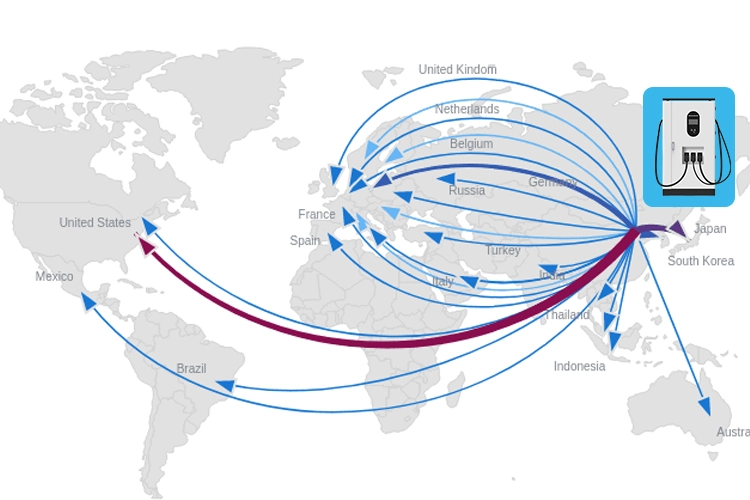
Global Expansion: Actively serving markets across Europe, Southeast Asia, and Central Asia, AnengJienergy combines advanced engineering with responsive local support.
With its “Smart Manufacturing + Tailored Service + Global Delivery” strategy, AnengJienergy has earned a reputation as a trusted partner for commercial EV charging projects worldwide.
III. Conclusion: The Future of the 2025 Charger EV Era
By 2025, the global EV charging industry will enter a new phase defined by intelligence, customization, and interoperability.
Regional Evolution: Europe will continue leading in standardization; Asia will drive innovation; while Central Asia and the Middle East open new opportunities for growth.
Industry Transformation: Manufacturers are evolving from hardware suppliers to end-to-end energy ecosystem providers.
New Leaders: Companies like AnengJienergy are reshaping the market through technological innovation, flexible production, and global service networks.
The “2025 Charger EV” era is not only about powering vehicles — it’s about redefining global energy infrastructure for a cleaner, smarter, and more connected future.